
Tags
Adverse Selection, Asymmetric Learning, Brazil, Managers, Personnel Management, Poaching, Raids, RAIS
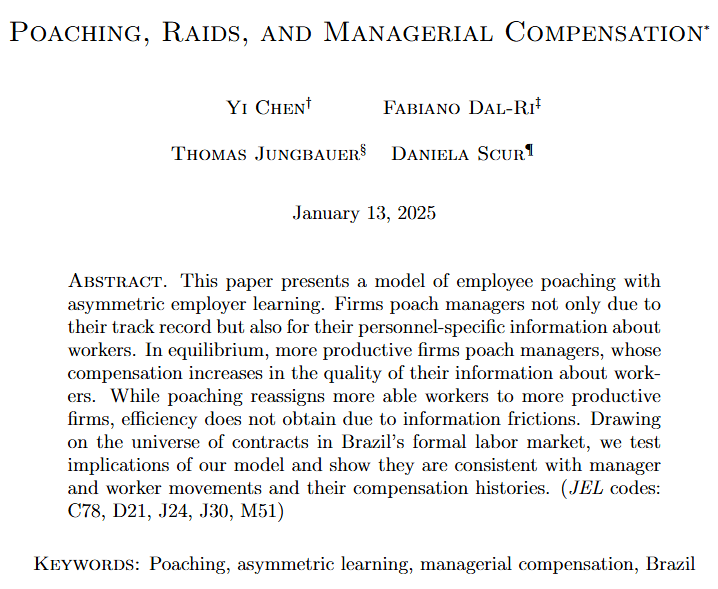
In Poaching, Raids, and Managerial Compensation—joint work with my friends and colleagues Yi Chen, Fabiano Dal-Ri and Daniela Scur—we develop a theory of managerial poaching and subsequent worker raids. We postulate that firms do not only poach managers for their skills but also for their personnel-specific knowledge about workers they supervise. In the equilibrium of our model with asymmetric employer learning, substantially more productive firms poach managers for the option value of identifying high-ability workers. When poaching firms pay thus pay twice for superior worker ability: once indirectly through the manager’s salary and once through the worker’s wage. The ensuing information rent for the manager is a result of firms attempting to protect themselves from raids of their high-ability workers by retaining their manager, leading to adverse selection of workers in the labor market.
We then derive seven theoretical predictions to test our model against data from Brazil’s formal sector: 1) Managers are poached by more productive firms. 2) When a firm poaches a manager from another firm, the firm is more likely to raid their workers. 3) Poached managers earn higher salaries. 4) The salary of a poached manager increases in the poaching firm’s demand for information, and 5) in the poaching firm’s supply of information. 6) The salary of a poached manager increases in the raided workers’ abilities. 7) Raided workers are of higher ability than non-raided workers.
Our empirical analysis provides strong support for our theoretical model and differentiates managerial poaching for personnel-specific information from potential other explanations of manager-worker com-movement such as workers referring others in their network or non-performance based favoritism in hiring. While we find limited evidence for both these phenomena, they are not consistent with the weight of our empirical evidence. On the hand, the effect of workers following managers is substantially larger than a worker-worker effect,

while on the other raided workers that follow a manager are of significantly higher ability than similar hires into the same firms, i.e.,

The intuition behind our results is potentially meaningful for recruiting and promotion strategy, investment in human capital, knowledge flow design within organizations, and the regulation of labor markets.

 A STABLE MATCH