
• About
  • Contact
  • The blogger

A STABLE MATCH

A STABLE MATCH

Category Archives: Innovation

The Governance of Abundance: Generative AI, Selective Permeability, and Complementor Strategy

14 Sunday Jun 2026

Posted by tjungbau in Academic Research, Artificial Intelligence, Digital Economics, Innovation, Platforms, Strategy

≈ Leave a comment

Tags

complementor strategy, GenAI, platform governance, provenance, selective permeability

The main message of my new paper “The Governance of Abundance: Generative AI, Selective Permeability, and Complementor Strategy” is simple to lay out but important: generative AI does not only make it easier to create more products, content, apps, books, videos, or other digital complements. It also makes it easier to make weak offerings look credible. That matters because platforms do not allocate exposure after they perfectly know what is good. They allocate exposure based on signals, rankings, labels, history, verification, and user responses that are themselves imperfect. Once AI makes surface plausibility cheaper, the platform’s problem changes from attracting enough complements to governing too many plausible-looking ones.

The core contribution is to separate two effects that are often blurred together in discussions of generative AI. One is the production effect: AI makes it cheaper to generate complements and can help complementors produce better-looking work. The other is the governance effect: AI can make the signals that platforms use to screen and rank complements less informative. The paper argues that these are not the same thing. A platform can become richer in content supply and poorer in trustworthy information at the same time.
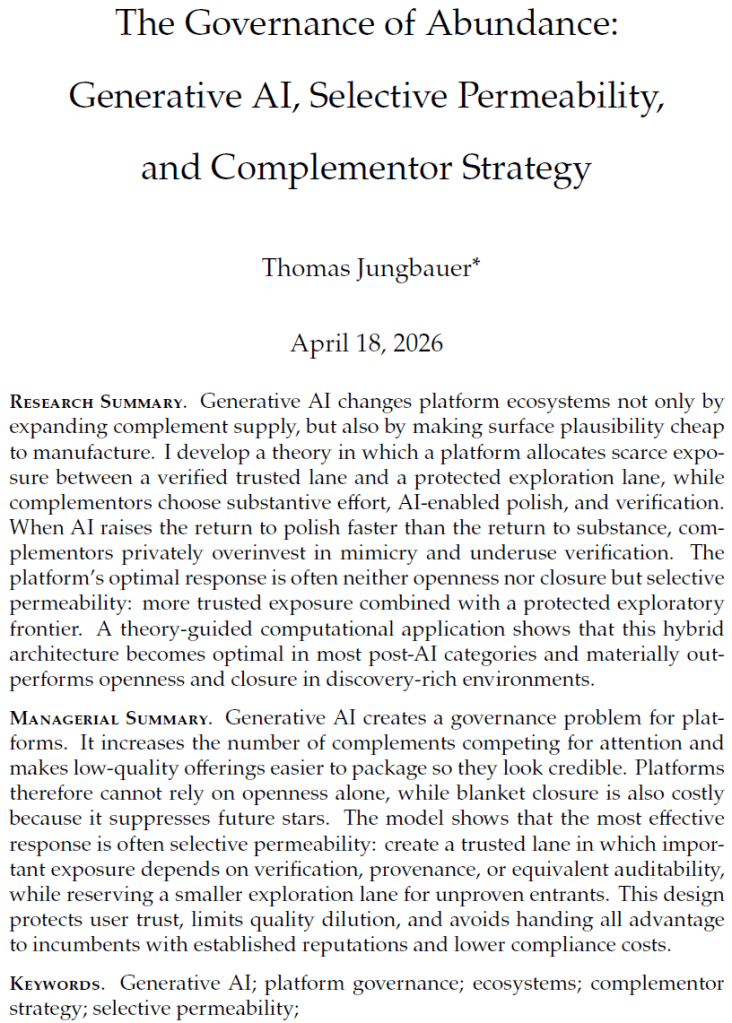
That distinction leads to the paper’s central governance idea: selective permeability. The platform should not necessarily choose between being open and being closed. Openness preserves entry and experimentation, but it can flood users with cheaply polished low-quality complements. Closure protects trust, but it can also suppress future stars and hand too much advantage to incumbents with established reputations and lower verification costs. Selective permeability is the middle architecture: a trusted lane for exposure that depends on verification, provenance, disclosure, or equivalent auditability, combined with a protected exploration lane for unproven entrants.

To study this problem, the paper develops a formal model in which a platform allocates scarce exposure between a trusted lane and an exploration lane. Complementors then choose whether to invest in substantive quality, AI-enabled polish, and verification. The key assumption is that generative AI raises the private return to polish faster than the return to substance. In equilibrium, complementors therefore have stronger incentives to invest in surface plausibility rather than in verified quality. The platform, however, has to internalize two things complementors do not: the trust loss from low-quality exposure and the option value of discovering future high-quality entrants.

The main result is that the best response is often neither full openness nor full closure. When trust matters but discovery also matters, the optimal governance design is hybrid. The platform expands trusted exposure where credibility is especially valuable, while reserving some exposure for exploratory discovery. In other words, the relevant question is not simply “Should the platform allow AI content?” The better question is “Which kinds of exposure should require verification, and how much room should remain for entrants who have not yet built a track record?”

The computational analysis makes this point more concrete. In the formal-model grid, selective permeability is optimal in 123 out of 144 post-AI cells, which means the hybrid regime is not just a knife-edge theoretical possibility. In a representative high-discovery category, selective permeability also outperforms both openness and closure in ecosystem value. It preserves more trust than openness and more discovery than closure. In the post-AI comparison, selective permeability delivers ecosystem value of 4.013, compared with 2.529 under openness and 2.388 under closure. It also raises trust relative to openness and increases discoveries relative to closure.

The paper also has an important implication for complementor strategy. Verification, provenance, and reputation become more valuable strategic assets when trusted exposure becomes more important. That means governance tightening is not neutral. It changes who wins inside the ecosystem. Established complementors and organizations with low compliance costs gain an advantage. But if the platform closes too much, it risks entrenching incumbents and starving itself of the next generation of valuable complements. Selective permeability is therefore not only a trust-protection device. It is also a way to manage the concentration effects of AI-era gatekeeping.

For managers, the practical message is that generative AI turns exposure design into a central strategic problem. Disclosure labels, provenance systems, verification rules, upload frictions, trusted badges, and protected discovery quotas are not merely technical add-ons to recommendation systems. They are governance instruments. They determine which complements receive credibility, which entrants remain discoverable, and how the ecosystem balances user trust against future innovation.

For a broader audience, the paper reframes the AI-platform debate. Much of the discussion asks whether generative AI creates more content or makes individual producers more productive. This paper says that is only half the question. The other half is whether platforms can still tell which complements deserve attention. If AI makes plausible-looking complements abundant but reliable signals scarce, then the strategic bottleneck is no longer production. It is the governance of abundance.
Selling Synergies

24 Tuesday Mar 2026

Posted by tjungbau in Academic Research, Antitrust, Innovation, Organization, Strategy

≈ Leave a comment

Tags

business, Complementarities, Market Distortion, Optimal Stopping, Preemption, Synergies, technology

The Synergy Trap: Why Interconnected Tech Often Launches Half-Baked

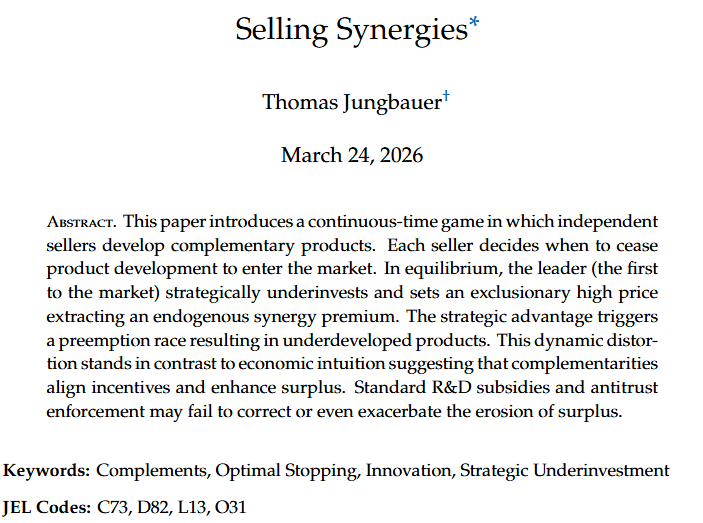
We usually assume that when companies build complementary products—like electric vehicles and charging networks, or hardware platforms and specialized software—the natural synergies align their incentives and create a win-win for everyone. But what happens when independent firms are developing these interconnected ecosystems over time? In my new paper “Selling Synergies,” I formally explores this dynamic by modeling two profit-maximizing sellers developing complementary products. Each firm continuously invests in product development and decides exactly when to stop refining, launch to the market, and set a price for consumers who exhibit a synergy benefit from owning both items.

The analysis reveals an interesting mechanism that turns these positive synergies into a source of inefficiency: the firm that launches first (the “leader”) has a strong incentive to strategically underinvest in their own product. By halting development early and launching a lower-quality product with an exclusionary, high price, the leader forces the second firm (the “follower”) into a corner. The follower is nudged to target the broader mass market and must continue developing their product to a high standard. This allows the leader to essentially free-ride on the follower’s hard work, extracting a lucrative “synergy premium” from early, high-paying buyers without putting in the development time themselves.

Because securing this leader position is so incredibly profitable—yielding more than a standard standalone monopoly would—a destructive “preemption race” kicks off. Both firms aim to capture the first-mover synergy premium that they try to undercut each other’s launch dates. Ultimately, this intense competition completely unwinds the very premium they were chasing. The race only stops when synergy rents profits are totally dissipated, resulting in companies rushing underdeveloped products to the market long before they are actually ready. Crucially, note that this rush to the market is not driven by an arms race between competitors who try to beat each other to the punch, but rather by an urge to dominate a fledgling ecosystem.

The results challenge standard economic and regulatory playbooks. While we intuitively expect product synergies to enhance overall value, this uncoordinated race actually destroys product quality and reduces overall market welfare. Government interventions like standard R&D subsidies may ease the preemption race but fail to address the core issue. What is more, some results suggest that standard antitrust policies aimed at preventing corporate mergers might actually backfire in these specific markets. A merged, joint monopoly that internalizes these synergies actually delays its product launches to build higher quality, ultimately benefiting both producers and consumers.

The Organization of Innovation: Property Rights and the Outsourcing Decision

04 Friday Dec 2020

Posted by tjungbau in Academic Research, Innovation

≈ Leave a comment

Tags

Outsourcing, Pharmaceutical Industry, R&D, Vertical Integration

Why do firms outsource research and development for some products while they opt to conduct R&D in-house for similar ones? In our new paper, Sean Nicholson, June Pan, Michael Waldman and I argue that companies want to protect their existing product portfolio. If a firm already successfully operates in a given product category, it is more reluctant to relinquish control of the research and development of new products in order to limit cannibalization of their existing successful products.

We build a novel theoretical model and show that a firm is more likely to conduct R&D for a new product in-house if a.) the company already sells a product in the same product category, b.) the longer the patent on the existing product, and c.) the higher the market share of the existing product are. Data from the pharmaceutical industry strongly supports our findings. We control for various measures of competition and patent existence to exclude simple category specific expertise as an explanation.

Recent Posts

  • The Governance of Abundance: Generative AI, Selective Permeability, and Complementor Strategy
  • Better Applications, Worse Matching: Artificial Intelligence and Talent Allocation
  • The Disruption of Attention Platforms by Generative AI
  • Selling Synergies
  • Search platforms rewrite the rules of online shopping

Recent Comments

Unknown's avatarEfficiency vs. distr… on Applying to multiple specialti…

Archives

  • June 2026
  • April 2026
  • March 2026
  • February 2026
  • November 2025
  • March 2025
  • January 2025
  • September 2024
  • December 2023
  • October 2023
  • December 2022
  • September 2021
  • August 2021
  • January 2021
  • December 2020
  • June 2020
  • March 2020
  • November 2019
  • November 2018
  • August 2018
  • July 2018
  • April 2018
  • December 2017
  • February 2017
  • January 2017
  • June 2016
  • April 2016
  • March 2016
  • January 2016
  • December 2015
  • November 2015
  • October 2015
  • September 2015

Categories

  • Academic Organizations
  • Academic Research
  • Antitrust
  • Artificial Intelligence
  • Auction
  • Austria
  • Corporate Social Responsibility
  • Democracy
  • Digital Economics
  • Economic Growth
  • Economics Laureates
  • Education
  • Electric Vehicles
  • Health
  • Inequality
  • Innovation
  • Labor
  • Learning
  • MBA
  • National Resident Matching Program
  • Online Advertising
  • Organization
  • Platforms
  • Politics
  • Probability
  • Self-Driving Cars
  • Signaling
  • Social Dilemma
  • Statistics
  • Strategy
  • Terrorism
  • UBER
  • Voting

Meta

  • Create account
  • Log in
  • Entries feed
  • Comments feed
  • WordPress.com

Recent Posts

  • The Governance of Abundance: Generative AI, Selective Permeability, and Complementor Strategy
  • Better Applications, Worse Matching: Artificial Intelligence and Talent Allocation
  • The Disruption of Attention Platforms by Generative AI
  • Selling Synergies
  • Search platforms rewrite the rules of online shopping

Recent Comments

Unknown's avatarEfficiency vs. distr… on Applying to multiple specialti…

Archives

  • June 2026
  • April 2026
  • March 2026
  • February 2026
  • November 2025
  • March 2025
  • January 2025
  • September 2024
  • December 2023
  • October 2023
  • December 2022
  • September 2021
  • August 2021
  • January 2021
  • December 2020
  • June 2020
  • March 2020
  • November 2019
  • November 2018
  • August 2018
  • July 2018
  • April 2018
  • December 2017
  • February 2017
  • January 2017
  • June 2016
  • April 2016
  • March 2016
  • January 2016
  • December 2015
  • November 2015
  • October 2015
  • September 2015

Categories

  • Academic Organizations
  • Academic Research
  • Antitrust
  • Artificial Intelligence
  • Auction
  • Austria
  • Corporate Social Responsibility
  • Democracy
  • Digital Economics
  • Economic Growth
  • Economics Laureates
  • Education
  • Electric Vehicles
  • Health
  • Inequality
  • Innovation
  • Labor
  • Learning
  • MBA
  • National Resident Matching Program
  • Online Advertising
  • Organization
  • Platforms
  • Politics
  • Probability
  • Self-Driving Cars
  • Signaling
  • Social Dilemma
  • Statistics
  • Strategy
  • Terrorism
  • UBER
  • Voting

Meta

  • Create account
  • Log in
  • Entries feed
  • Comments feed
  • WordPress.com

Blog at WordPress.com.

  • Subscribe Subscribed
    • A STABLE MATCH
    • Already have a WordPress.com account? Log in now.
    • A STABLE MATCH
    • Subscribe Subscribed
    • Sign up
    • Log in
    • Report this content
    • View site in Reader
    • Manage subscriptions
    • Collapse this bar

Loading Comments...