
• About
  • Contact
  • The blogger

A STABLE MATCH

A STABLE MATCH

Category Archives: Online Advertising

Algorithm Transparency and Search Manipulation: Steering vs. Persuasion

12 Wednesday Aug 2026

Posted by tjungbau in Strategy, Academic Research, Online Advertising, Digital Economics, Platforms

≈ Leave a comment

Tags

Consumer Search, persuasion, prominence, search manipulation, steering, transparency

In “Algorithm Transparency and Search Manipulation: Steering vs. Persuasion” (with Raphael Boleslavsky and Mehdi Shadmehr) we study a familiar feature of digital markets that is easy to overlook. Platforms do not merely decide which products are available. They decide which product consumers encounter first. That choice matters because prominence affects attention, continuation search, and ultimately which seller is considered. But rankings can do something else as well. When consumers understand how a platform’s private information affects its ranking, prominence becomes a signal. A ranking can therefore both steer consumers by changing their search path and persuade them by changing what they believe.
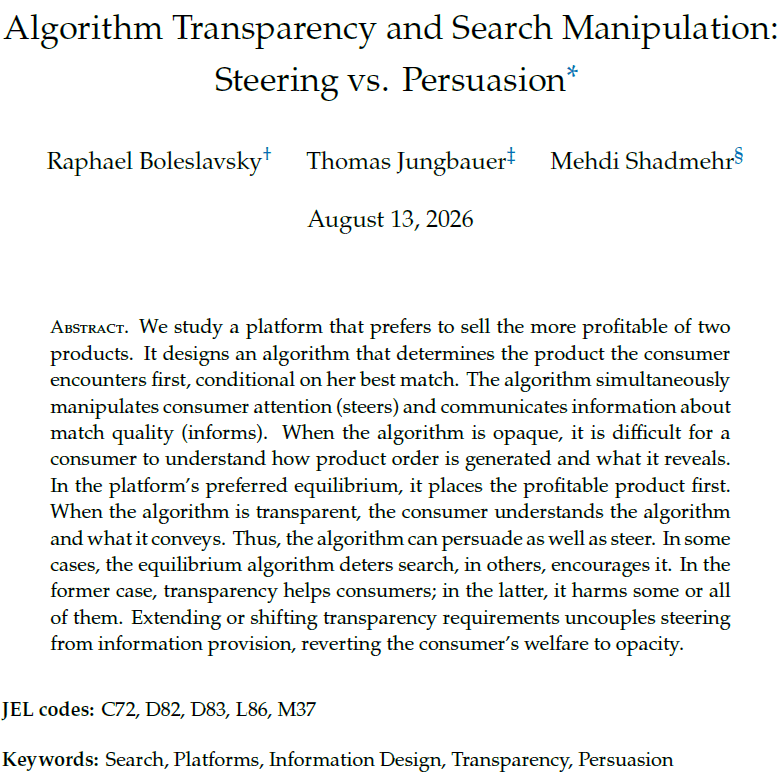
We introduce a model featuring a platform that, due to its vast consumer data, privately knows which of two products is the better match for a consumer but earns more from selling one of them. Some consumers buy the prominent product immediately, while others can continue searching at a cost. When the ranking algorithm is opaque, the platform’s preferred equilibrium simply places the more profitable product first. Transparency of the ranking algorithm changes the problem. Once consumers understand the state-contingent ranking rule, the platform can commit to making the ranking informative. It may use positive sorting, placing the profitable product first as favorable news and persuading consumers to stop searching. It may also instead use negative sorting, placing the alternative first in a way that makes consumers sufficiently optimistic about the profitable product to continue searching for it.

Positive sorting benefits both consumers with lower and higher search costs. Negative sorting harms consumers who never search and buy the prominent product, while those able to search may gain or lose depending on the strength of search and information frictions. A further result complicates the usual policy intuition that broader transparency must be better. If the platform can issue a transparent recommendation separately from the ranking, it no longer needs to sacrifice prominence in order to communicate. It keeps the profitable product first and moves persuasion into the recommendation layer. Platform profit rises, but the consumer gains created by a transparent ranking disappear. Transparency is therefore not only about how much a platform explains. Its architecture matters.

The broader implication is relevant for platform managers, economists, and regulators. A ranking is both a message and an allocation of attention. Transparency can discipline a platform when its claims must be embodied in the same prominence decision that shapes consumers’ search costs. That discipline weakens when recommendations become a separate, costless messaging layer. One possible policy principle is therefore recommendation–display consistency. When a platform recommends a product on the basis of information unavailable to consumers, it should also make that product correspondingly easy to inspect and purchase. In less formal terms, platforms may need to put their money where their mouth is.

Search platforms rewrite the rules of online shopping

18 Wednesday Feb 2026

Posted by tjungbau in Digital Economics, Online Advertising, Platforms

≈ Leave a comment

Tags

Market power, Online platforms, Search advertising

The Cornell Chronicle published a nice piece called “Search platforms rewrite the rules of online shopping” breaking down the main message and policy relevance of my paper “Search Platforms: Big Data and Sponsored Positions,” joint with Maarten Janssen, Marcel Preuss and Cole Williams that recently published in the Economic Journal. The main message conveyed: It’s not necessarily advertiser-funded search results that harm consumers, but search platform market power.

Online Advertising, Data Sharing, and Consumer Control

06 Friday Aug 2021

Posted by tjungbau in Academic Research, Auction, Online Advertising

≈ Leave a comment

Tags

Cross-Targeting, Data Sharing, Online Advertising Auctions

When advertisers share consumer-relevant data (e.g., that they have visited the advertiser’s website) with ad exchanges, the facilitators of targeting consumers across the web and online advertisement auctions, these ad exchanges do not offer to share this information with other rival advertisers in the same product category. This is even true if all parties in the market (ad exchanges, advertisers, consumers, publishers) were be better off in case more information was shared.

We identify the strong property rights of advertisers (website owners) as the culprit of this undersharing of information (ad exchanges cater to advertisers with restrictive data sharing policies), and show that small tweaks such as endowing consumers with easier ways not to be tracked can even worsen that situation. Instead what it takes is a system that weakens advertisers’ property rights over consumer-generated information. When consumers are for example allowed to directly share purchase intent in a product category with ad exchanges, advertisers in equilibrium share more information themselves enabling very efficient “cross-targeting” of consumers. We show that even highly criticized initiatives such as those by Google and Apple to abandon third-party cookies may improve consumer welfare by altering the current system.

Recent Posts

  • Algorithm Transparency and Search Manipulation: Steering vs. Persuasion
  • The Governance of Abundance: Generative AI, Selective Permeability, and Complementor Strategy
  • Better Applications, Worse Matching: Artificial Intelligence and Talent Allocation
  • The Disruption of Attention Platforms by Generative AI
  • Selling Synergies

Recent Comments

Unknown's avatarEfficiency vs. distr… on Applying to multiple specialti…

Archives

  • August 2026
  • June 2026
  • April 2026
  • March 2026
  • February 2026
  • November 2025
  • March 2025
  • January 2025
  • September 2024
  • December 2023
  • October 2023
  • December 2022
  • September 2021
  • August 2021
  • January 2021
  • December 2020
  • June 2020
  • March 2020
  • November 2019
  • November 2018
  • August 2018
  • July 2018
  • April 2018
  • December 2017
  • February 2017
  • January 2017
  • June 2016
  • April 2016
  • March 2016
  • January 2016
  • December 2015
  • November 2015
  • October 2015
  • September 2015

Categories

  • Academic Organizations
  • Academic Research
  • Antitrust
  • Artificial Intelligence
  • Auction
  • Austria
  • Corporate Social Responsibility
  • Democracy
  • Digital Economics
  • Economic Growth
  • Economics Laureates
  • Education
  • Electric Vehicles
  • Health
  • Inequality
  • Innovation
  • Labor
  • Learning
  • MBA
  • National Resident Matching Program
  • Online Advertising
  • Organization
  • Platforms
  • Politics
  • Probability
  • Self-Driving Cars
  • Signaling
  • Social Dilemma
  • Statistics
  • Strategy
  • Terrorism
  • UBER
  • Voting

Meta

  • Create account
  • Log in
  • Entries feed
  • Comments feed
  • WordPress.com

Recent Posts

  • Algorithm Transparency and Search Manipulation: Steering vs. Persuasion
  • The Governance of Abundance: Generative AI, Selective Permeability, and Complementor Strategy
  • Better Applications, Worse Matching: Artificial Intelligence and Talent Allocation
  • The Disruption of Attention Platforms by Generative AI
  • Selling Synergies

Recent Comments

Unknown's avatarEfficiency vs. distr… on Applying to multiple specialti…

Archives

  • August 2026
  • June 2026
  • April 2026
  • March 2026
  • February 2026
  • November 2025
  • March 2025
  • January 2025
  • September 2024
  • December 2023
  • October 2023
  • December 2022
  • September 2021
  • August 2021
  • January 2021
  • December 2020
  • June 2020
  • March 2020
  • November 2019
  • November 2018
  • August 2018
  • July 2018
  • April 2018
  • December 2017
  • February 2017
  • January 2017
  • June 2016
  • April 2016
  • March 2016
  • January 2016
  • December 2015
  • November 2015
  • October 2015
  • September 2015

Categories

  • Academic Organizations
  • Academic Research
  • Antitrust
  • Artificial Intelligence
  • Auction
  • Austria
  • Corporate Social Responsibility
  • Democracy
  • Digital Economics
  • Economic Growth
  • Economics Laureates
  • Education
  • Electric Vehicles
  • Health
  • Inequality
  • Innovation
  • Labor
  • Learning
  • MBA
  • National Resident Matching Program
  • Online Advertising
  • Organization
  • Platforms
  • Politics
  • Probability
  • Self-Driving Cars
  • Signaling
  • Social Dilemma
  • Statistics
  • Strategy
  • Terrorism
  • UBER
  • Voting

Meta

  • Create account
  • Log in
  • Entries feed
  • Comments feed
  • WordPress.com

Blog at WordPress.com.

  • Subscribe Subscribed
    • A STABLE MATCH
    • Already have a WordPress.com account? Log in now.
    • A STABLE MATCH
    • Subscribe Subscribed
    • Sign up
    • Log in
    • Report this content
    • View site in Reader
    • Manage subscriptions
    • Collapse this bar
Loading Comments...