
Tags
Asymmetric Employer Learning, Education, Education Signaling, Employer Learning Speed, employer-learning, industry, Industry Mismatch, Industry Signaling, Signaling, Symmetric Employer Learning
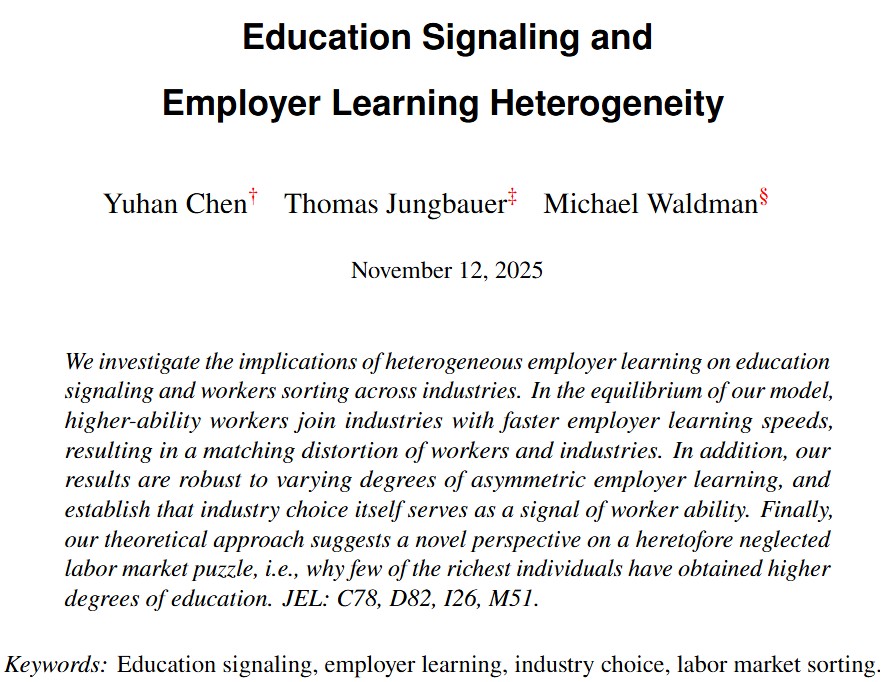
It is well known that individuals choose to obtain higher education degrees to signal their ability to potential employers (Education Signaling), and that employers learn about their workers’ abilities from observing their output over time (Employer Learning). The quicker and the more accurate employers learn about their workers, the less important education is as a signal of their ability.
In “Education Signaling and Employer Learning Heterogeneity,” (joint with Yuhan Chen and Michael Waldman), we investigate the consequences of combining these fundamental concepts of Labor Economics. In particular, we exploit the fact that the importance of teamwork and other determinants of the observability of individual output not under the worker’s control vary across industries (and occupations).
When industries differ in their speed (or accuracy) of employer learning, higher-ability workers tend to prefer a faster-learning environment. This is because they prefer their compensation depends on their own output, a function of their ability, rather than on the ability of others choosing the same education signal (e.g., degree). This is not the case for lower-ability workers, however, who benefit when the average ability of those choosing the same education is a determinant of their compensation. This finding has several important consequences.
First, as higher-ability workers face a strong incentive to choose a faster- rather than a slower-learning industry, they even join the faster-learning industry if they are more productive in the slower-learning industry. In other words, a sorting distortion regarding industry choice arises and lowers social welfare. Second, for any given education level, higher-ability workers choose a faster-learning industry. As a result, industry choice itself is a signal of worker ability on which employers condition their learning. Third, the sorting distortion across industries lowers education investment for signaling purposes, increasing social welfare.
We show that the logic of our results persists across industries with symmetric and asymmetric employer learning components, i.e., whether the worker’s current employer is better informed about their ability than their competitors. Likewise, our results are robust to different bidding specifications among firms, i.e., whether firms engage in simultaneous bidding for workers, or the worker’s current employer can submit counteroffers.
A variant of our model in which workers learn their productivity difference across industries before they choose their education level offers a potential explanation for a heretofore neglected labor market “puzzle:” why do few of the economically most successful individuals in real-world labor markets hold higher education degrees? We show that fewer workers that join a faster-learning industry choose higher education levels. In particular, if industries or occupations differ greatly in their speed or asymmetry of learning, it may be the the highest ability individuals in a faster-learning industry or occupation that achieve the highest lifetime wages but choose a low education level. The non-monotonicity of education levels in ability in our model is novel, and lends itself well to explain the success of entrepreneurs choosing low education levels or to drop out of school. Finally, we discuss the testable implications of our theory, and how it connects to existing empirical work.
 A STABLE MATCH