
• About
  • Contact
  • The blogger

A STABLE MATCH

A STABLE MATCH

Category Archives: Learning

Optimally Informative Rankings and Consumer Search

14 Friday Nov 2025

Posted by tjungbau in Academic Research, Digital Economics, Learning, Platforms, Signaling, Strategy

≈ Leave a comment

Tags

Consumer Search, Consumer welfare, Informativeness, Obfuscation, Product rankings

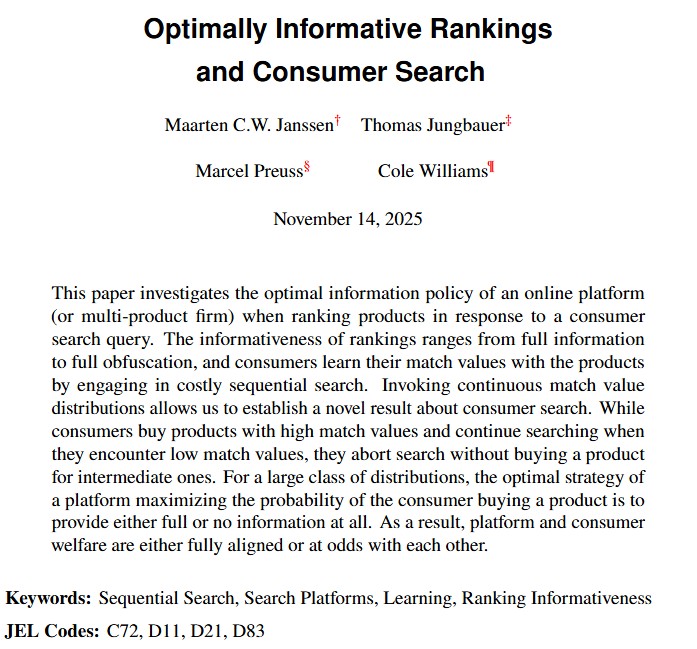
Online platforms (and multi-product firms) generate lists of products (or services) in response to consumer search queries. In ranking these products, platforms draw on their vast amount of information about past consumer search behavior and their purchase history. In “Optimally Informative Rankings and Consumer Search” (joint with Maarten Janssen, Marcel Preuss and Cole Williams), we investigate how much of their pertinent information platforms convey through their rankings of products.

When consumers engage in costly search and expect to find some products they like better and others they like less, they are updating their expectations about the remaining alternatives whenever they inspect a product. As a result, three scenarios ensue: 1) If they like a product very much, they immediately buy. 2) If they strongly dislike a product, they become more optimistic about the remaining alternatives and continue searching. 3) If however, the consumer is fairly indifferent about a product, they may neither buy it nor continue to search as their experience does not induce sufficient optimism about the remaining products. In turn, they abort search altogether without buying a product.

Scenario 3) is a novel finding about consumer search with learning and has meaningful implications for platforms and their regulators. Understanding optimal consumer search behavior, we derive the optimal platform ranking of two products, one of which promises a higher value for the consumer (in expectation) and one a lower value. The more informative the platform’s ranking, i.e., the higher the probability it puts the higher-value product in the first position of their ranking, the higher the likelihood the consumer (inspects and) buys the first product. However, if the consumer does not like the first product, they are less likely to inspect the second the more informative the ranking, i.e., the less likely the product in the second position is the higher-value product.

It turns out that the platform optimally chooses to obfuscate their ranking to increase the probability of the consumer to inspect both products when consumer search cost (i.e., their implicit cost of inspecting another item) is low, but to provide a fully informative ranking to increase the probability the consumer buys the first product if the consumer’s search cost is high. Interestingly, the platform provides either less information than would be necessary to induce search of the second product, or more information than necessary to ensure the consumer’s participation in search in the first place. An intriguing result of our findings is that platform and consumer welfare are aligned only if search cost is high (in which case the platform maximizes social welfare) but at odds with each other when search cost is low.
Education Signaling and Employer Learning Heterogeneity

12 Wednesday Nov 2025

Posted by tjungbau in Academic Research, Education, Labor, Learning, Organization, Signaling

≈ Leave a comment

Tags

Asymmetric Employer Learning, Education, Education Signaling, Employer Learning Speed, employer-learning, industry, Industry Mismatch, Industry Signaling, Signaling, Symmetric Employer Learning

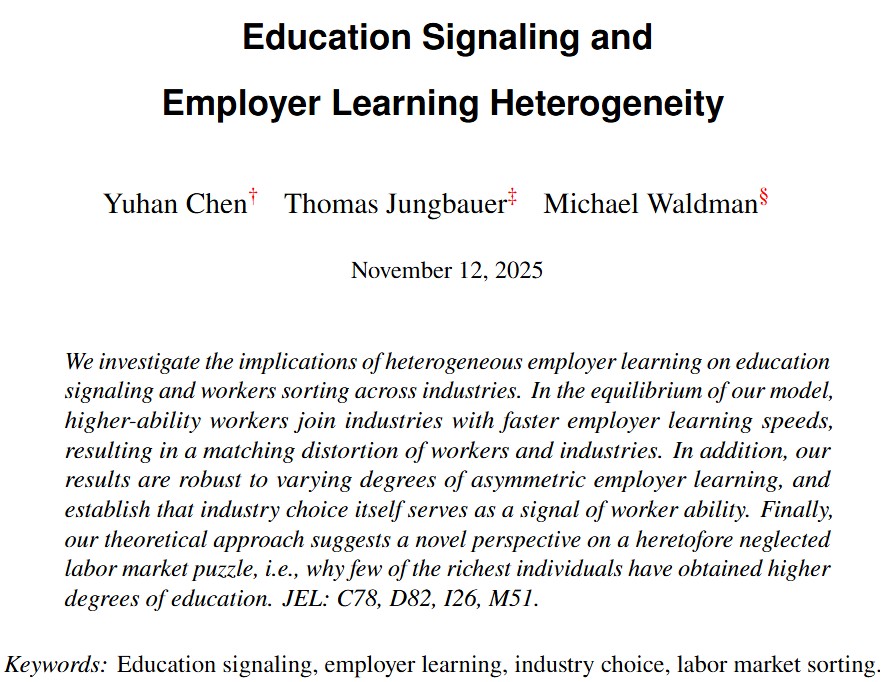
It is well known that individuals choose to obtain higher education degrees to signal their ability to potential employers (Education Signaling), and that employers learn about their workers’ abilities from observing their output over time (Employer Learning). The quicker and the more accurate employers learn about their workers, the less important education is as a signal of their ability.

In “Education Signaling and Employer Learning Heterogeneity,” (joint with Yuhan Chen and Michael Waldman), we investigate the consequences of combining these fundamental concepts of Labor Economics. In particular, we exploit the fact that the importance of teamwork and other determinants of the observability of individual output not under the worker’s control vary across industries (and occupations).

When industries differ in their speed (or accuracy) of employer learning, higher-ability workers tend to prefer a faster-learning environment. This is because they prefer their compensation depends on their own output, a function of their ability, rather than on the ability of others choosing the same education signal (e.g., degree). This is not the case for lower-ability workers, however, who benefit when the average ability of those choosing the same education is a determinant of their compensation. This finding has several important consequences.

First, as higher-ability workers face a strong incentive to choose a faster- rather than a slower-learning industry, they even join the faster-learning industry if they are more productive in the slower-learning industry. In other words, a sorting distortion regarding industry choice arises and lowers social welfare. Second, for any given education level, higher-ability workers choose a faster-learning industry. As a result, industry choice itself is a signal of worker ability on which employers condition their learning. Third, the sorting distortion across industries lowers education investment for signaling purposes, increasing social welfare.

We show that the logic of our results persists across industries with symmetric and asymmetric employer learning components, i.e., whether the worker’s current employer is better informed about their ability than their competitors. Likewise, our results are robust to different bidding specifications among firms, i.e., whether firms engage in simultaneous bidding for workers, or the worker’s current employer can submit counteroffers.

A variant of our model in which workers learn their productivity difference across industries before they choose their education level offers a potential explanation for a heretofore neglected labor market “puzzle:” why do few of the economically most successful individuals in real-world labor markets hold higher education degrees? We show that fewer workers that join a faster-learning industry choose higher education levels. In particular, if industries or occupations differ greatly in their speed or asymmetry of learning, it may be the the highest ability individuals in a faster-learning industry or occupation that achieve the highest lifetime wages but choose a low education level. The non-monotonicity of education levels in ability in our model is novel, and lends itself well to explain the success of entrepreneurs choosing low education levels or to drop out of school. Finally, we discuss the testable implications of our theory, and how it connects to existing empirical work.

Recent Posts

  • Optimally Informative Rankings and Consumer Search
  • Education Signaling and Employer Learning Heterogeneity
  • Strategic Referrals among Experts
  • Poaching, Raids, and Managerial Compensation
  • Strategic Wage Posting, Market Power and Mismatch

Recent Comments

Unknown's avatarEfficiency vs. distr… on Applying to multiple specialti…

Archives

  • November 2025
  • March 2025
  • January 2025
  • September 2024
  • December 2023
  • October 2023
  • December 2022
  • September 2021
  • August 2021
  • January 2021
  • December 2020
  • June 2020
  • March 2020
  • November 2019
  • November 2018
  • August 2018
  • July 2018
  • April 2018
  • December 2017
  • February 2017
  • January 2017
  • June 2016
  • April 2016
  • March 2016
  • January 2016
  • December 2015
  • November 2015
  • October 2015
  • September 2015

Categories

  • Academic Organizations
  • Academic Research
  • Antitrust
  • Auction
  • Austria
  • Corporate Social Responsibility
  • Democracy
  • Digital Economics
  • Economic Growth
  • Economics Laureates
  • Education
  • Electric Vehicles
  • Health
  • Inequality
  • Innovation
  • Labor
  • Learning
  • MBA
  • National Resident Matching Program
  • Online Advertising
  • Organization
  • Platforms
  • Politics
  • Probability
  • Self-Driving Cars
  • Signaling
  • Social Dilemma
  • Statistics
  • Strategy
  • Terrorism
  • UBER
  • Voting

Meta

  • Create account
  • Log in
  • Entries feed
  • Comments feed
  • WordPress.com

Recent Posts

  • Optimally Informative Rankings and Consumer Search
  • Education Signaling and Employer Learning Heterogeneity
  • Strategic Referrals among Experts
  • Poaching, Raids, and Managerial Compensation
  • Strategic Wage Posting, Market Power and Mismatch

Recent Comments

Unknown's avatarEfficiency vs. distr… on Applying to multiple specialti…

Archives

  • November 2025
  • March 2025
  • January 2025
  • September 2024
  • December 2023
  • October 2023
  • December 2022
  • September 2021
  • August 2021
  • January 2021
  • December 2020
  • June 2020
  • March 2020
  • November 2019
  • November 2018
  • August 2018
  • July 2018
  • April 2018
  • December 2017
  • February 2017
  • January 2017
  • June 2016
  • April 2016
  • March 2016
  • January 2016
  • December 2015
  • November 2015
  • October 2015
  • September 2015

Categories

  • Academic Organizations
  • Academic Research
  • Antitrust
  • Auction
  • Austria
  • Corporate Social Responsibility
  • Democracy
  • Digital Economics
  • Economic Growth
  • Economics Laureates
  • Education
  • Electric Vehicles
  • Health
  • Inequality
  • Innovation
  • Labor
  • Learning
  • MBA
  • National Resident Matching Program
  • Online Advertising
  • Organization
  • Platforms
  • Politics
  • Probability
  • Self-Driving Cars
  • Signaling
  • Social Dilemma
  • Statistics
  • Strategy
  • Terrorism
  • UBER
  • Voting

Meta

  • Create account
  • Log in
  • Entries feed
  • Comments feed
  • WordPress.com

Blog at WordPress.com.

Privacy & Cookies: This site uses cookies. By continuing to use this website, you agree to their use.
To find out more, including how to control cookies, see here: Cookie Policy
  • Subscribe Subscribed
    • A STABLE MATCH
    • Already have a WordPress.com account? Log in now.
    • A STABLE MATCH
    • Subscribe Subscribed
    • Sign up
    • Log in
    • Report this content
    • View site in Reader
    • Manage subscriptions
    • Collapse this bar
 

Loading Comments...