
• About
  • Contact
  • The blogger

A STABLE MATCH

A STABLE MATCH

Tag Archives: labor market sorting

Better Applications, Worse Matching: Artificial Intelligence and Talent Allocation

08 Wednesday Apr 2026

Posted by tjungbau in Academic Research, Artificial Intelligence, Digital Economics, Labor, Learning, Organization, Social Dilemma

≈ Leave a comment

Tags

ai, empirical design, GenAI, labor market sorting

The main message of my new paper “Better Applications, Worse Matching: Artificial Intelligence and Talent Allocation” is simple but important: generative AI can make everyone look better on paper, can, in fact, even make everyone more productive in everything their doing, yet the labor market may be worse off. AI can help applicants write cleaner resumes, sharper cover letters, and more polished work samples. But hiring does not happen after firms fully know who will perform best in the job. It happens earlier, based on imperfect screening materials. The paper shows that if AI improves those materials’ appearance while making them less informative about actual fit, then matching workers to jobs can deteriorate even as AI raises productivity inside every single job.
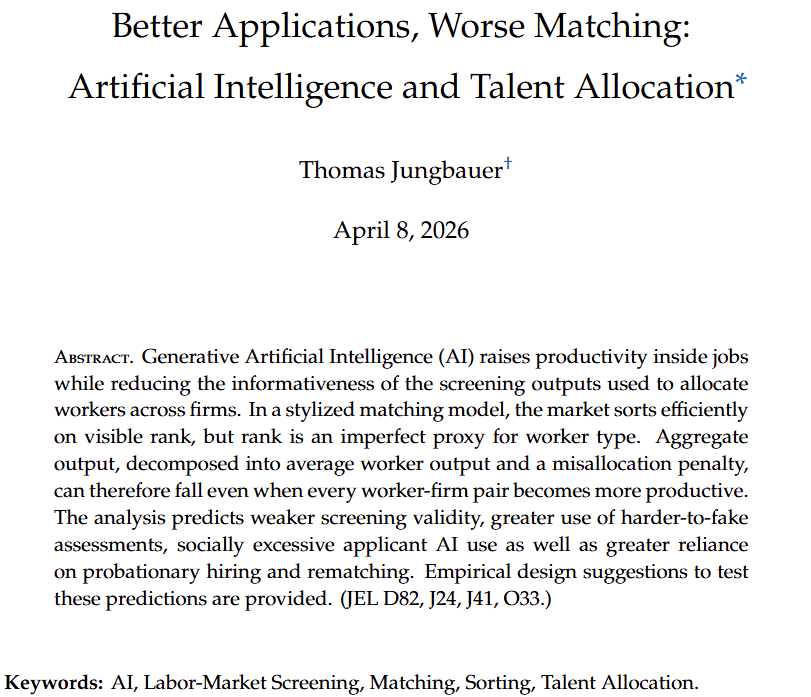
The core contribution is to separate two effects that are often blurred together in public discussion. One is what AI does inside a job once someone is hired, i.e., it may help them write faster, code better, or complete tasks more efficiently. The other effect is what AI does before hiring. It may change how informative applications, interviews or work samples are. The paper argues that these are not the same thing. A labor market can continue to sort efficiently on the basis of the information it sees, yet still produce worse matches if the visible ranking of applicants becomes a poorer guide to underlying talent and job fit.

That distinction leads to a n interesting theoretical result. Even if AI makes every possible worker–firm pairing more productive, total output in the economy can still fall if the screening stage gets worse enough. In other words, better applications do not necessarily mean better matching. The paper also argues that this creates an “arms race” on the applicant side. While using AI to polish applications may be privately attractive for each worker, it becomes socially excessive when everyone does it. Once firms can no longer rely as much on first-round materials, they are predicted to respond by using more verification, more work-sample tests, more probationary hiring, and more early post-hire evaluation.

For a broader audience, the paper’s contribution is to reframe the conversation about AI and work. Much of the debate asks whether AI makes workers more productive. This paper says that is only half the question. The other half is whether AI improves or degrades the information used to allocate people to opportunities in the first place. That is important for everyone trying to understand and test whether AI increases the performance of a specific labor market.

Recent Posts

  • Better Applications, Worse Matching: Artificial Intelligence and Talent Allocation
  • The Disruption of Attention Platforms by Generative AI
  • Selling Synergies
  • Search platforms rewrite the rules of online shopping
  • Optimally Informative Rankings and Consumer Search

Recent Comments

Unknown's avatarEfficiency vs. distr… on Applying to multiple specialti…

Archives

  • April 2026
  • March 2026
  • February 2026
  • November 2025
  • March 2025
  • January 2025
  • September 2024
  • December 2023
  • October 2023
  • December 2022
  • September 2021
  • August 2021
  • January 2021
  • December 2020
  • June 2020
  • March 2020
  • November 2019
  • November 2018
  • August 2018
  • July 2018
  • April 2018
  • December 2017
  • February 2017
  • January 2017
  • June 2016
  • April 2016
  • March 2016
  • January 2016
  • December 2015
  • November 2015
  • October 2015
  • September 2015

Categories

  • Academic Organizations
  • Academic Research
  • Antitrust
  • Artificial Intelligence
  • Auction
  • Austria
  • Corporate Social Responsibility
  • Democracy
  • Digital Economics
  • Economic Growth
  • Economics Laureates
  • Education
  • Electric Vehicles
  • Health
  • Inequality
  • Innovation
  • Labor
  • Learning
  • MBA
  • National Resident Matching Program
  • Online Advertising
  • Organization
  • Platforms
  • Politics
  • Probability
  • Self-Driving Cars
  • Signaling
  • Social Dilemma
  • Statistics
  • Strategy
  • Terrorism
  • UBER
  • Voting

Meta

  • Create account
  • Log in
  • Entries feed
  • Comments feed
  • WordPress.com

Recent Posts

  • Better Applications, Worse Matching: Artificial Intelligence and Talent Allocation
  • The Disruption of Attention Platforms by Generative AI
  • Selling Synergies
  • Search platforms rewrite the rules of online shopping
  • Optimally Informative Rankings and Consumer Search

Recent Comments

Unknown's avatarEfficiency vs. distr… on Applying to multiple specialti…

Archives

  • April 2026
  • March 2026
  • February 2026
  • November 2025
  • March 2025
  • January 2025
  • September 2024
  • December 2023
  • October 2023
  • December 2022
  • September 2021
  • August 2021
  • January 2021
  • December 2020
  • June 2020
  • March 2020
  • November 2019
  • November 2018
  • August 2018
  • July 2018
  • April 2018
  • December 2017
  • February 2017
  • January 2017
  • June 2016
  • April 2016
  • March 2016
  • January 2016
  • December 2015
  • November 2015
  • October 2015
  • September 2015

Categories

  • Academic Organizations
  • Academic Research
  • Antitrust
  • Artificial Intelligence
  • Auction
  • Austria
  • Corporate Social Responsibility
  • Democracy
  • Digital Economics
  • Economic Growth
  • Economics Laureates
  • Education
  • Electric Vehicles
  • Health
  • Inequality
  • Innovation
  • Labor
  • Learning
  • MBA
  • National Resident Matching Program
  • Online Advertising
  • Organization
  • Platforms
  • Politics
  • Probability
  • Self-Driving Cars
  • Signaling
  • Social Dilemma
  • Statistics
  • Strategy
  • Terrorism
  • UBER
  • Voting

Meta

  • Create account
  • Log in
  • Entries feed
  • Comments feed
  • WordPress.com

Blog at WordPress.com.

  • Subscribe Subscribed
    • A STABLE MATCH
    • Already have a WordPress.com account? Log in now.
    • A STABLE MATCH
    • Subscribe Subscribed
    • Sign up
    • Log in
    • Report this content
    • View site in Reader
    • Manage subscriptions
    • Collapse this bar
 

Loading Comments...