
• About
  • Contact
  • The blogger

A STABLE MATCH

A STABLE MATCH

Tag Archives: GenAI

The Governance of Abundance: Generative AI, Selective Permeability, and Complementor Strategy

14 Sunday Jun 2026

Posted by tjungbau in Academic Research, Artificial Intelligence, Digital Economics, Innovation, Platforms, Strategy

≈ Leave a comment

Tags

complementor strategy, GenAI, platform governance, provenance, selective permeability

The main message of my new paper “The Governance of Abundance: Generative AI, Selective Permeability, and Complementor Strategy” is simple to lay out but important: generative AI does not only make it easier to create more products, content, apps, books, videos, or other digital complements. It also makes it easier to make weak offerings look credible. That matters because platforms do not allocate exposure after they perfectly know what is good. They allocate exposure based on signals, rankings, labels, history, verification, and user responses that are themselves imperfect. Once AI makes surface plausibility cheaper, the platform’s problem changes from attracting enough complements to governing too many plausible-looking ones.

The core contribution is to separate two effects that are often blurred together in discussions of generative AI. One is the production effect: AI makes it cheaper to generate complements and can help complementors produce better-looking work. The other is the governance effect: AI can make the signals that platforms use to screen and rank complements less informative. The paper argues that these are not the same thing. A platform can become richer in content supply and poorer in trustworthy information at the same time.
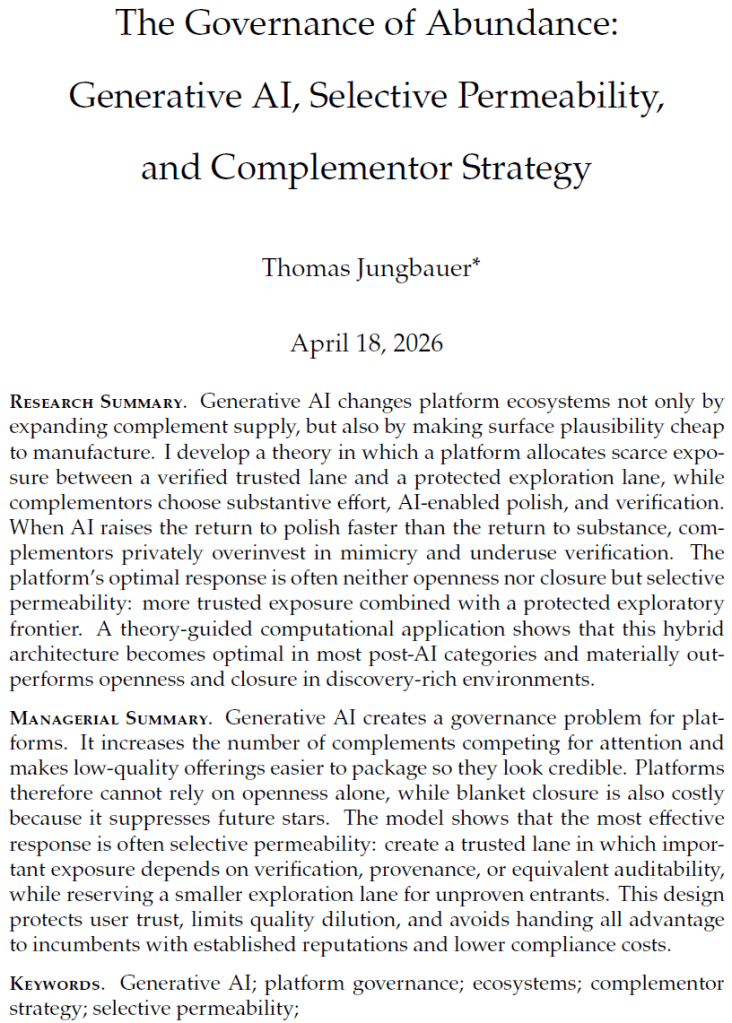
That distinction leads to the paper’s central governance idea: selective permeability. The platform should not necessarily choose between being open and being closed. Openness preserves entry and experimentation, but it can flood users with cheaply polished low-quality complements. Closure protects trust, but it can also suppress future stars and hand too much advantage to incumbents with established reputations and lower verification costs. Selective permeability is the middle architecture: a trusted lane for exposure that depends on verification, provenance, disclosure, or equivalent auditability, combined with a protected exploration lane for unproven entrants.

To study this problem, the paper develops a formal model in which a platform allocates scarce exposure between a trusted lane and an exploration lane. Complementors then choose whether to invest in substantive quality, AI-enabled polish, and verification. The key assumption is that generative AI raises the private return to polish faster than the return to substance. In equilibrium, complementors therefore have stronger incentives to invest in surface plausibility rather than in verified quality. The platform, however, has to internalize two things complementors do not: the trust loss from low-quality exposure and the option value of discovering future high-quality entrants.

The main result is that the best response is often neither full openness nor full closure. When trust matters but discovery also matters, the optimal governance design is hybrid. The platform expands trusted exposure where credibility is especially valuable, while reserving some exposure for exploratory discovery. In other words, the relevant question is not simply “Should the platform allow AI content?” The better question is “Which kinds of exposure should require verification, and how much room should remain for entrants who have not yet built a track record?”

The computational analysis makes this point more concrete. In the formal-model grid, selective permeability is optimal in 123 out of 144 post-AI cells, which means the hybrid regime is not just a knife-edge theoretical possibility. In a representative high-discovery category, selective permeability also outperforms both openness and closure in ecosystem value. It preserves more trust than openness and more discovery than closure. In the post-AI comparison, selective permeability delivers ecosystem value of 4.013, compared with 2.529 under openness and 2.388 under closure. It also raises trust relative to openness and increases discoveries relative to closure.

The paper also has an important implication for complementor strategy. Verification, provenance, and reputation become more valuable strategic assets when trusted exposure becomes more important. That means governance tightening is not neutral. It changes who wins inside the ecosystem. Established complementors and organizations with low compliance costs gain an advantage. But if the platform closes too much, it risks entrenching incumbents and starving itself of the next generation of valuable complements. Selective permeability is therefore not only a trust-protection device. It is also a way to manage the concentration effects of AI-era gatekeeping.

For managers, the practical message is that generative AI turns exposure design into a central strategic problem. Disclosure labels, provenance systems, verification rules, upload frictions, trusted badges, and protected discovery quotas are not merely technical add-ons to recommendation systems. They are governance instruments. They determine which complements receive credibility, which entrants remain discoverable, and how the ecosystem balances user trust against future innovation.

For a broader audience, the paper reframes the AI-platform debate. Much of the discussion asks whether generative AI creates more content or makes individual producers more productive. This paper says that is only half the question. The other half is whether platforms can still tell which complements deserve attention. If AI makes plausible-looking complements abundant but reliable signals scarce, then the strategic bottleneck is no longer production. It is the governance of abundance.
Better Applications, Worse Matching: Artificial Intelligence and Talent Allocation

08 Wednesday Apr 2026

Posted by tjungbau in Academic Research, Artificial Intelligence, Digital Economics, Labor, Learning, Organization, Social Dilemma

≈ Leave a comment

Tags

ai, empirical design, GenAI, labor market sorting

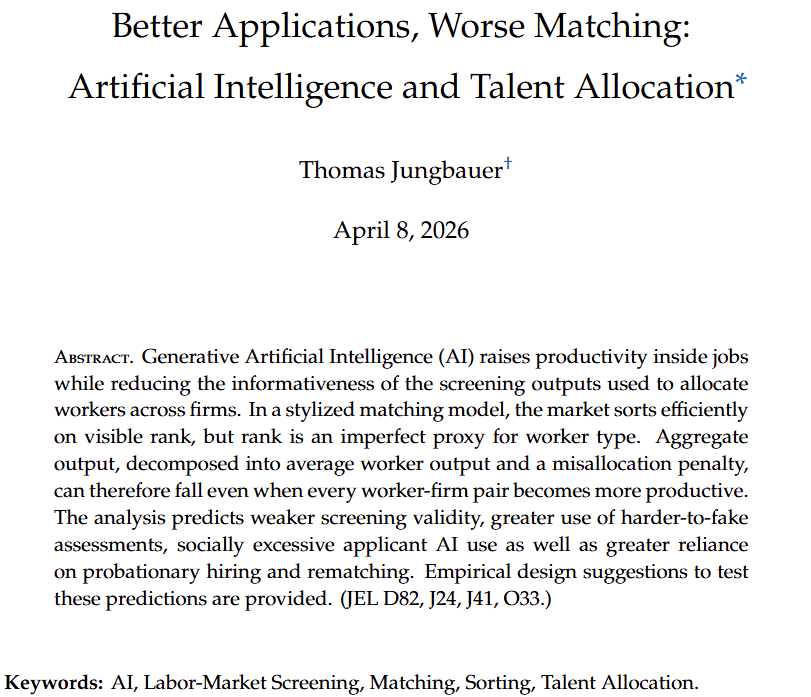
The main message of my new paper “Better Applications, Worse Matching: Artificial Intelligence and Talent Allocation” is simple but important: generative AI can make everyone look better on paper, can, in fact, even make everyone more productive in everything their doing, yet the labor market may be worse off. AI can help applicants write cleaner resumes, sharper cover letters, and more polished work samples. But hiring does not happen after firms fully know who will perform best in the job. It happens earlier, based on imperfect screening materials. The paper shows that if AI improves those materials’ appearance while making them less informative about actual fit, then matching workers to jobs can deteriorate even as AI raises productivity inside every single job.

The core contribution is to separate two effects that are often blurred together in public discussion. One is what AI does inside a job once someone is hired, i.e., it may help them write faster, code better, or complete tasks more efficiently. The other effect is what AI does before hiring. It may change how informative applications, interviews or work samples are. The paper argues that these are not the same thing. A labor market can continue to sort efficiently on the basis of the information it sees, yet still produce worse matches if the visible ranking of applicants becomes a poorer guide to underlying talent and job fit.

That distinction leads to a n interesting theoretical result. Even if AI makes every possible worker–firm pairing more productive, total output in the economy can still fall if the screening stage gets worse enough. In other words, better applications do not necessarily mean better matching. The paper also argues that this creates an “arms race” on the applicant side. While using AI to polish applications may be privately attractive for each worker, it becomes socially excessive when everyone does it. Once firms can no longer rely as much on first-round materials, they are predicted to respond by using more verification, more work-sample tests, more probationary hiring, and more early post-hire evaluation.

For a broader audience, the paper’s contribution is to reframe the conversation about AI and work. Much of the debate asks whether AI makes workers more productive. This paper says that is only half the question. The other half is whether AI improves or degrades the information used to allocate people to opportunities in the first place. That is important for everyone trying to understand and test whether AI increases the performance of a specific labor market.

The Disruption of Attention Platforms by Generative AI

04 Saturday Apr 2026

Posted by tjungbau in Academic Research, Artificial Intelligence, Digital Economics, Platforms, Strategy

≈ Leave a comment

Tags

Attention Platforms, GenAI, Instagram, Recommender Systems, TikTok, YouTube

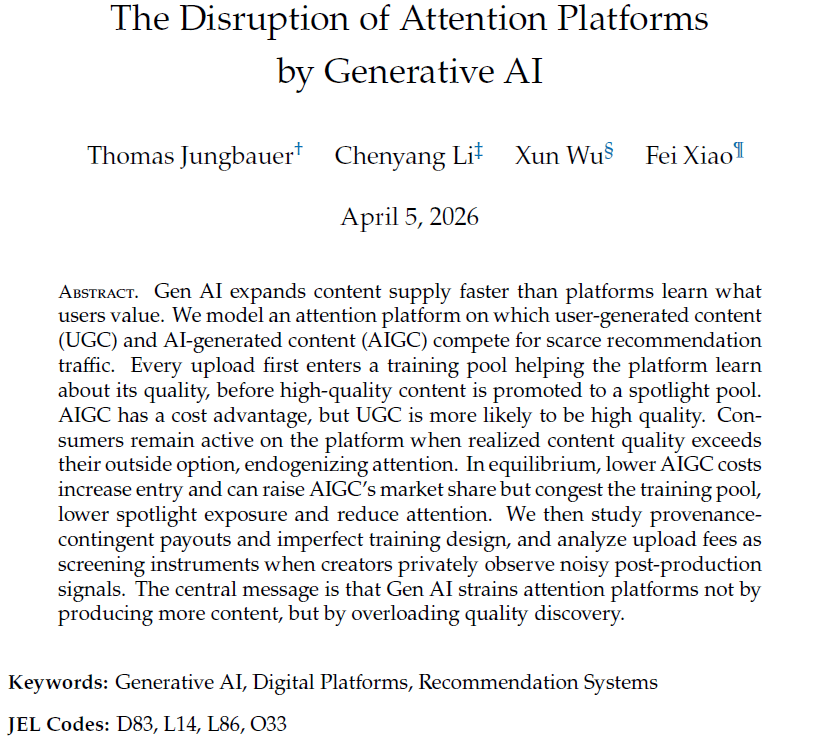
Generative AI is changing digital platforms in a very specific way, it explodes content supply but it is not creating more human attention. That matters because platforms do not make money from raw upload volume. Rather, they make money from keeping users engaged with content they actually value. My new paper “The Disruption of Attention Platforms by Generative AI,” with Chenyang Li, Xun Wu and Fei Xiao, argues that this creates a new management problem for attention platforms. The core challenge is no longer just how to attract more creators, but how to govern a flood of cheap AI-generated content when the truly scarce resource is informative user attention.

To study this problem, we introduce a simple but powerful framework. On the platform, both user-generated content and AI-generated content compete for recommendation traffic. Every upload first enters a “training pool,” where the platform uses early views to learn whether the content is good enough to deserve wider distribution. Only the content that proves itself is promoted into a “spotlight pool.” In the model, AI-generated content is cheaper to produce, but user-generated content is more likely to be high quality. Users stay on the platform only if their experience is good enough relative to what they could do elsewhere, so bad content does not just waste impressions today. It can also reduce future attention.

The main result is striking: cheaper AI-generated content can make a platform worse off even while it increases supply. The reason is congestion in quality discovery. When too many low-hit-rate uploads enter the system, the platform must spend more scarce human attention evaluating content. As a result, it has less attention left to amplify the winners. That lowers spotlight exposure, reduces realized average quality, and can even shrink the platform’s effective attention budget as users disengage. In other words, more content is not always better. If supply grows faster than the platform’s ability to identify value, abundance can become a liability rather than an asset.

The practical message is not at all that “AI is bad.” It is that AI changes what good platform governance looks like. The paper shows why tools such as provenance-based payouts, better disclosure, upload fees, and multi-stage screening can all matter. They help platforms allocate scarce attention more intelligently and keep low-signal content from overwhelming discovery. For managers, that shifts the strategic question from “Should we allow AI content?” to “How should we redesign incentives and screening when content is cheap but attention is not?” That is a useful lens not just for social media, but for any digital platform whose value depends on matching users with quality at scale.

Recent Posts

  • The Governance of Abundance: Generative AI, Selective Permeability, and Complementor Strategy
  • Better Applications, Worse Matching: Artificial Intelligence and Talent Allocation
  • The Disruption of Attention Platforms by Generative AI
  • Selling Synergies
  • Search platforms rewrite the rules of online shopping

Recent Comments

Unknown's avatarEfficiency vs. distr… on Applying to multiple specialti…

Archives

  • June 2026
  • April 2026
  • March 2026
  • February 2026
  • November 2025
  • March 2025
  • January 2025
  • September 2024
  • December 2023
  • October 2023
  • December 2022
  • September 2021
  • August 2021
  • January 2021
  • December 2020
  • June 2020
  • March 2020
  • November 2019
  • November 2018
  • August 2018
  • July 2018
  • April 2018
  • December 2017
  • February 2017
  • January 2017
  • June 2016
  • April 2016
  • March 2016
  • January 2016
  • December 2015
  • November 2015
  • October 2015
  • September 2015

Categories

  • Academic Organizations
  • Academic Research
  • Antitrust
  • Artificial Intelligence
  • Auction
  • Austria
  • Corporate Social Responsibility
  • Democracy
  • Digital Economics
  • Economic Growth
  • Economics Laureates
  • Education
  • Electric Vehicles
  • Health
  • Inequality
  • Innovation
  • Labor
  • Learning
  • MBA
  • National Resident Matching Program
  • Online Advertising
  • Organization
  • Platforms
  • Politics
  • Probability
  • Self-Driving Cars
  • Signaling
  • Social Dilemma
  • Statistics
  • Strategy
  • Terrorism
  • UBER
  • Voting

Meta

  • Create account
  • Log in
  • Entries feed
  • Comments feed
  • WordPress.com

Recent Posts

  • The Governance of Abundance: Generative AI, Selective Permeability, and Complementor Strategy
  • Better Applications, Worse Matching: Artificial Intelligence and Talent Allocation
  • The Disruption of Attention Platforms by Generative AI
  • Selling Synergies
  • Search platforms rewrite the rules of online shopping

Recent Comments

Unknown's avatarEfficiency vs. distr… on Applying to multiple specialti…

Archives

  • June 2026
  • April 2026
  • March 2026
  • February 2026
  • November 2025
  • March 2025
  • January 2025
  • September 2024
  • December 2023
  • October 2023
  • December 2022
  • September 2021
  • August 2021
  • January 2021
  • December 2020
  • June 2020
  • March 2020
  • November 2019
  • November 2018
  • August 2018
  • July 2018
  • April 2018
  • December 2017
  • February 2017
  • January 2017
  • June 2016
  • April 2016
  • March 2016
  • January 2016
  • December 2015
  • November 2015
  • October 2015
  • September 2015

Categories

  • Academic Organizations
  • Academic Research
  • Antitrust
  • Artificial Intelligence
  • Auction
  • Austria
  • Corporate Social Responsibility
  • Democracy
  • Digital Economics
  • Economic Growth
  • Economics Laureates
  • Education
  • Electric Vehicles
  • Health
  • Inequality
  • Innovation
  • Labor
  • Learning
  • MBA
  • National Resident Matching Program
  • Online Advertising
  • Organization
  • Platforms
  • Politics
  • Probability
  • Self-Driving Cars
  • Signaling
  • Social Dilemma
  • Statistics
  • Strategy
  • Terrorism
  • UBER
  • Voting

Meta

  • Create account
  • Log in
  • Entries feed
  • Comments feed
  • WordPress.com

Blog at WordPress.com.

  • Subscribe Subscribed
    • A STABLE MATCH
    • Already have a WordPress.com account? Log in now.
    • A STABLE MATCH
    • Subscribe Subscribed
    • Sign up
    • Log in
    • Report this content
    • View site in Reader
    • Manage subscriptions
    • Collapse this bar

Loading Comments...