• About
  • Contact
  • The blogger

A STABLE MATCH

A STABLE MATCH

Author Archives: tjungbau

Optimally Informative Rankings and Consumer Search

14 Friday Nov 2025

Posted by tjungbau in Academic Research, Digital Economics, Learning, Platforms, Signaling, Strategy

≈ Leave a comment

Tags

Consumer Search, Consumer welfare, Informativeness, Obfuscation, Product rankings

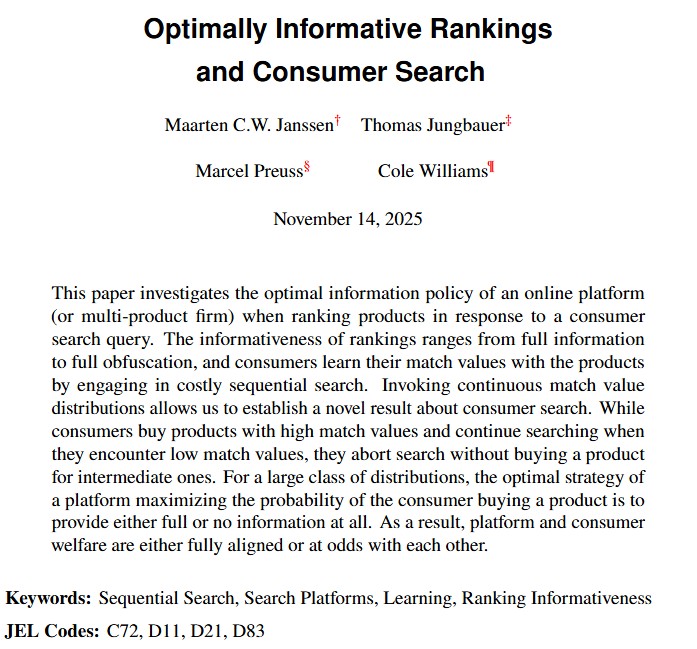
Online platforms (and multi-product firms) generate lists of products (or services) in response to consumer search queries. In ranking these products, platforms draw on their vast amount of information about past consumer search behavior and their purchase history. In “Optimally Informative Rankings and Consumer Search” (joint with Maarten Janssen, Marcel Preuss and Cole Williams), we investigate how much of their pertinent information platforms convey through their rankings of products.

When consumers engage in costly search and expect to find some products they like better and others they like less, they are updating their expectations about the remaining alternatives whenever they inspect a product. As a result, three scenarios ensue: 1) If they like a product very much, they immediately buy. 2) If they strongly dislike a product, they become more optimistic about the remaining alternatives and continue searching. 3) If however, the consumer is fairly indifferent about a product, they may neither buy it nor continue to search as their experience does not induce sufficient optimism about the remaining products. In turn, they abort search altogether without buying a product.

Scenario 3) is a novel finding about consumer search with learning and has meaningful implications for platforms and their regulators. Understanding optimal consumer search behavior, we derive the optimal platform ranking of two products, one of which promises a higher value for the consumer (in expectation) and one a lower value. The more informative the platform’s ranking, i.e., the higher the probability it puts the higher-value product in the first position of their ranking, the higher the likelihood the consumer (inspects and) buys the first product. However, if the consumer does not like the first product, they are less likely to inspect the second the more informative the ranking, i.e., the less likely the product in the second position is the higher-value product.

It turns out that the platform optimally chooses to obfuscate their ranking to increase the probability of the consumer to inspect both products when consumer search cost (i.e., their implicit cost of inspecting another item) is low, but to provide a fully informative ranking to increase the probability the consumer buys the first product if the consumer’s search cost is high. Interestingly, the platform provides either less information than would be necessary to induce search of the second product, or more information than necessary to ensure the consumer’s participation in search in the first place. An intriguing result of our findings is that platform and consumer welfare are aligned only if search cost is high (in which case the platform maximizes social welfare) but at odds with each other when search cost is low.

Education Signaling and Employer Learning Heterogeneity

12 Wednesday Nov 2025

Posted by tjungbau in Academic Research, Education, Labor, Learning, Organization, Signaling

≈ Leave a comment

Tags

Asymmetric Employer Learning, Education, Education Signaling, Employer Learning Speed, employer-learning, industry, Industry Mismatch, Industry Signaling, Signaling, Symmetric Employer Learning

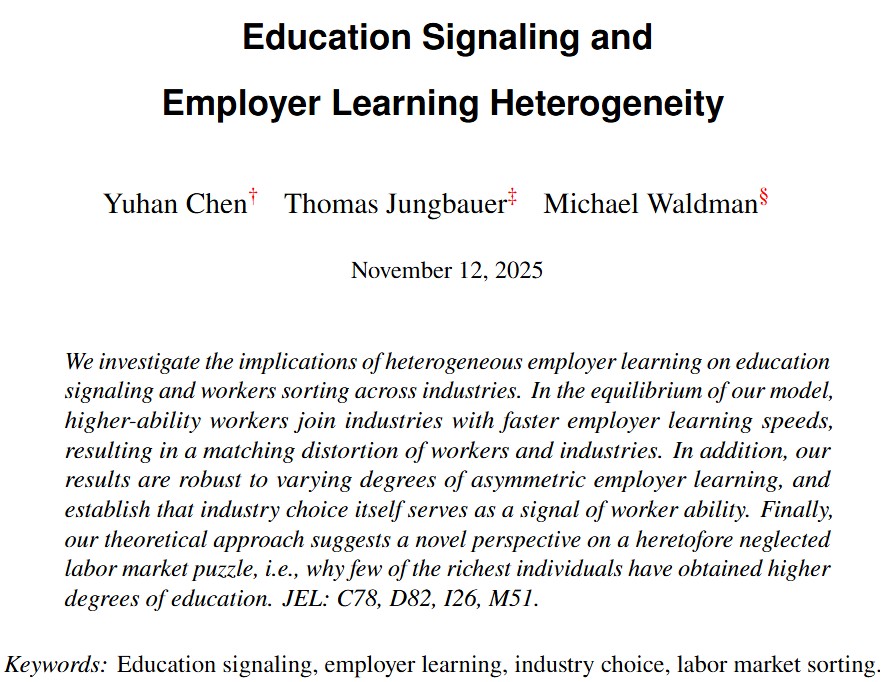
It is well known that individuals choose to obtain higher education degrees to signal their ability to potential employers (Education Signaling), and that employers learn about their workers’ abilities from observing their output over time (Employer Learning). The quicker and the more accurate employers learn about their workers, the less important education is as a signal of their ability.

In “Education Signaling and Employer Learning Heterogeneity,” (joint with Yuhan Chen and Michael Waldman), we investigate the consequences of combining these fundamental concepts of Labor Economics. In particular, we exploit the fact that the importance of teamwork and other determinants of the observability of individual output not under the worker’s control vary across industries (and occupations).

When industries differ in their speed (or accuracy) of employer learning, higher-ability workers tend to prefer a faster-learning environment. This is because they prefer their compensation depends on their own output, a function of their ability, rather than on the ability of others choosing the same education signal (e.g., degree). This is not the case for lower-ability workers, however, who benefit when the average ability of those choosing the same education is a determinant of their compensation. This finding has several important consequences.

First, as higher-ability workers face a strong incentive to choose a faster- rather than a slower-learning industry, they even join the faster-learning industry if they are more productive in the slower-learning industry. In other words, a sorting distortion regarding industry choice arises and lowers social welfare. Second, for any given education level, higher-ability workers choose a faster-learning industry. As a result, industry choice itself is a signal of worker ability on which employers condition their learning. Third, the sorting distortion across industries lowers education investment for signaling purposes, increasing social welfare.

We show that the logic of our results persists across industries with symmetric and asymmetric employer learning components, i.e., whether the worker’s current employer is better informed about their ability than their competitors. Likewise, our results are robust to different bidding specifications among firms, i.e., whether firms engage in simultaneous bidding for workers, or the worker’s current employer can submit counteroffers.

A variant of our model in which workers learn their productivity difference across industries before they choose their education level offers a potential explanation for a heretofore neglected labor market “puzzle:” why do few of the economically most successful individuals in real-world labor markets hold higher education degrees? We show that fewer workers that join a faster-learning industry choose higher education levels. In particular, if industries or occupations differ greatly in their speed or asymmetry of learning, it may be the the highest ability individuals in a faster-learning industry or occupation that achieve the highest lifetime wages but choose a low education level. The non-monotonicity of education levels in ability in our model is novel, and lends itself well to explain the success of entrepreneurs choosing low education levels or to drop out of school. Finally, we discuss the testable implications of our theory, and how it connects to existing empirical work.

Strategic Referrals among Experts

02 Sunday Mar 2025

Posted by tjungbau in Academic Research, Antitrust, Labor, Organization

≈ Leave a comment

Tags

Artificial Intelligence, Doctors, Dynamic games, Lawyers, Referrals, Reputation

Matching problems with the right expertise within and across firms is essential for the functioning of the economy. When problems are complex, however, their owners are often unaware of their exact nature, and costly diagnosis by an expert is required. This is why the initial allocation of problems is often independent of an expert’s specialization, but is affected by publicly available information of the expert’s past success rate in solving problems. Prospective clients, for example, consult medical providers with higher satisfaction scores or lawyers with better track records, while firms allocate problems to managers who got the job done in the past. The services of experts in these scenarios can be described as reputation goods. Reputation goods are (1) differentiated between sellers, (2) their product quality is consumer specific (3) and initially uncertain, (4) important, and thus (5) worth considerable information acquisition effort. In order to strengthen their reputation, thereby increasing demand for their services, experts sometimes find it worthwhile to forego compensation and sometimes refer problems to other experts who may be a better fit.

In Strategic Referrals among Experts (joint with Yi Chen and Mark Satterthwaite), we build a dynamic model to examine how reputational concerns of specialized experts shape their referral behavior and, as a consequence, market outcomes. We find that competition for problems among individual experts does in general not result in an efficient allocation of problems across experts. What is more, instead of sharpening their expertise, experts may want to invest in their abilities outside of their specialty—to the detriment of the economy. This issue may be exacerbated by the adoption of Artificial Intelligence (AI) in the workplace, often increasing professionals’ productivity outside their main specialty. Also, market efficiency increases in the experts’ compensation for diagnosing problems relative to treatment, potentially discouraging them from specializing in the first place. We show that referral alliances that set referral prices may alleviate these issues, though possibly at the expense of some experts. Pareto-efficient market outcomes generally require revenue sharing beyond referrals, i.e., some form of partnership contract. It is therefore imperative to account for referral incentives when regulating markets for professionals.

Our model features an economy with a mass of experts of two different types, who compete against each other for problems in continuous time. Each problem belongs to one of two categories, matching the experts’ types. That is to say, an expert has an absolute advantage (higher success rate) in treating problems of their category, i.e., those that match their type. Since problems require costly diagnosis, the demand for an expert’s services, i.e., the problems they receive, is independent of the expert’s type. An expert initially diagnoses problems, and then, for each problem, decides whether to to treat it or refer it to a more apt expert.

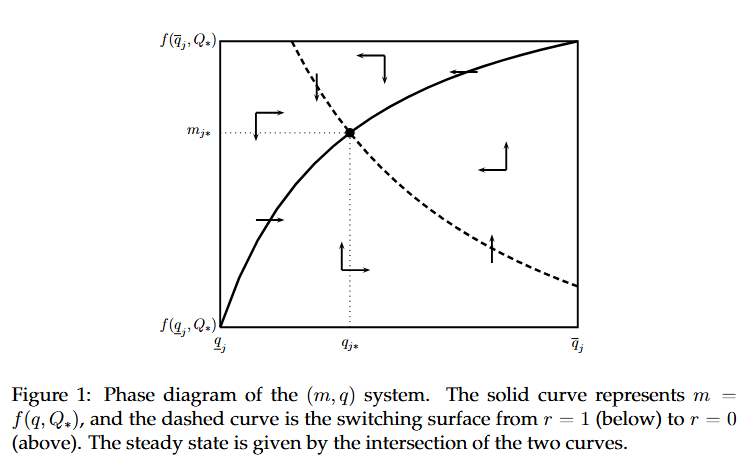
The demand for an expert’s services at any point in time depends on their own and other experts’ record of solving problems. An expert can solve a problem by either treating it successfully or by referring it to another expert who then treats it successfully. An expert’s record is characterized by its thickness—the decaying number of problems they diagnosed over time—and the expert’s reputation—their decaying historic success rate in solving problems. Reputation is directly payoff-relevant in that demand for the expert’s services increases in their reputation but decreases in an aggregate index of the their competitors’ reputation, perhaps the market average. The record’s thickness, on the other hand, does not directly affect demand but the inertia of the expert’s reputation. The thicker an expert’s record, the less today’s success rate matter in determining reputation.

We describe experts’ referral behavior in the unique steady state Markov equilibrium of our model. Uniqueness of the steady state follows from a feedback loop induced by the laws of motion that determine the expert’s record. As an expert refers more mismatched problems, their reputation increases, and so does their demand leading to a thicker record. Then, ultimately a tipping point is reached, at which reputation becomes sufficiently inert to the current success rate. As a result, the expert ceases to refer, and, ultimately, their record’ thickness decreases. This feedback loop is illustrated in the phase diagram below:

Poaching, Raids, and Managerial Compensation

13 Monday Jan 2025

Posted by tjungbau in Academic Research, Labor, Organization

≈ Leave a comment

Tags

Adverse Selection, Asymmetric Learning, Brazil, Managers, Personnel Management, Poaching, Raids, RAIS

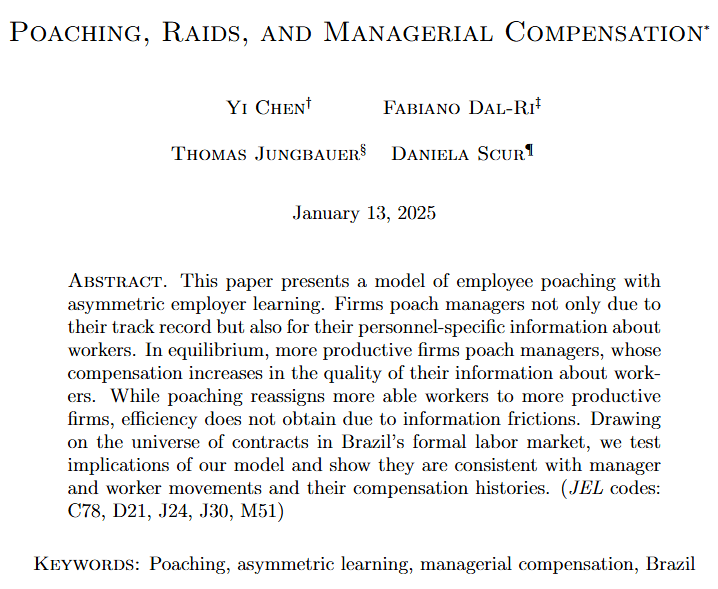
In Poaching, Raids, and Managerial Compensation—joint work with my friends and colleagues Yi Chen, Fabiano Dal-Ri and Daniela Scur—we develop a theory of managerial poaching and subsequent worker raids. We postulate that firms do not only poach managers for their skills but also for their personnel-specific knowledge about workers they supervise. In the equilibrium of our model with asymmetric employer learning, substantially more productive firms poach managers for the option value of identifying high-ability workers. When poaching firms pay thus pay twice for superior worker ability: once indirectly through the manager’s salary and once through the worker’s wage. The ensuing information rent for the manager is a result of firms attempting to protect themselves from raids of their high-ability workers by retaining their manager, leading to adverse selection of workers in the labor market.

We then derive seven theoretical predictions to test our model against data from Brazil’s formal sector: 1) Managers are poached by more productive firms. 2) When a firm poaches a manager from another firm, the firm is more likely to raid their workers. 3) Poached managers earn higher salaries. 4) The salary of a poached manager increases in the poaching firm’s demand for information, and 5) in the poaching firm’s supply of information. 6) The salary of a poached manager increases in the raided workers’ abilities. 7) Raided workers are of higher ability than non-raided workers.

Our empirical analysis provides strong support for our theoretical model and differentiates managerial poaching for personnel-specific information from potential other explanations of manager-worker com-movement such as workers referring others in their network or non-performance based favoritism in hiring. While we find limited evidence for both these phenomena, they are not consistent with the weight of our empirical evidence. On the hand, the effect of workers following managers is substantially larger than a worker-worker effect,

while on the other raided workers that follow a manager are of significantly higher ability than similar hires into the same firms, i.e.,

The intuition behind our results is potentially meaningful for recruiting and promotion strategy, investment in human capital, knowledge flow design within organizations, and the regulation of labor markets.

Strategic Wage Posting, Market Power and Mismatch

26 Thursday Sep 2024

Posted by tjungbau in Academic Research, Labor, Organization

≈ Leave a comment

Tags

Game Theory, Journal of Labor Economics, Market power, Mismatch, Wage posting

Nine years after starting work on this paper it finally published in the Journal of the Labor Economics. My gratitude goes to a fantastic editor, Kevin Lang at Boston University, and three anonymous referees whose suggestions made the paper a stronger and more robust contribution to labor market theory.

The main idea conveyed in this paper is as follows: When firms compete for heterogeneous workers in a well-defined labor market, larger firms have an incentive to lower wages more than their small competitors. If firms pay all their workers equally, the result is intuitive: it is more expensive for a large firm to raise wages than for its smaller competitors.

Strikingly, however, the result remains true even if firms post different wages for their positions. The decisive force behind this result is that when a firm hires a worker of high ability, the set of workers its other open positions compete for becomes less attractive. This externality is stronger for firms with more open positions, and therefore more market power. As such, firms that enjoy higher levels of market power may end up recruiting lower ability workers.

In this paper, I show that the resulting inefficiency, i.e., mismatch when assortative matching is desirable, may be quite substantial, and that the result is robust to sequential wage posting.

Actions and Signals

24 Sunday Dec 2023

Posted by tjungbau in Education, Signaling

≈ Leave a comment

Tags

Certification, College attended, Generalized Signaling, Signal jamming, Third-party reviews, Under-investment

In the canonical signaling model, a sender holding private information about her type chooses an action to change the beliefs of uninformed receivers about her type, e.g., a (future) worker chooses a higher education level to signal her ability. In other words, the chosen action serves as a signal of her privately known type. There are numerous examples of real-world settings that feature signaling, however, that work differently.

Suppose that, instead, the sender privately observes her type, and choses unobservable actions that together with her type determine an observable outcome, which acts then as a signal of both the sender’s type and her chosen actions. For example, consider the college attended by a worker. A more prestigious institution serves as a signal of both the innate ability or skill of the worker as well as of her effort in high-school and in studying for standardized tests. The worker, however, clearly does not choose her college, but her effort in high-school, volunteering, test prep, etc.

In “Actions and Signals,” co-authored with my colleague Mike Waldman, we introduce a generalized model of signaling that captures strategic incentives in these environments. We show that in equilibrium, a fundamentally different behavior than in the canonical signaling model, a special case of our framework, can arise.

If an action and a signal are one and the same, receivers know the sender’s action, and infer her type from the signal. In this scenario, over-investment, i.e. the sender choosing an action (=signal) that exceeds its efficient level, ensues (independent of whether the action is productive or not). This is because the sender gets rewarded for her action (as observed by receivers) but chooses an even higher level of the action to communicate that she is a higher type sender.

On the other hand, if an unobservable action and the sender’s type combine to generate an observable outcome that serves as a signal of both the action and her type, a different logic applies. When the sender chooses a higher level of the action, the signal increases. Receivers attribute some of this increase to a higher action and some of the increase to a higher type. As a result, equilibrium behavior of the sender depends on how the action and the sender’s type contribute to the observable signal vs. how they contribute to the sender’s output (for which receivers pay). In fact, if the action chosen by the sender is less important (relative to her type) for the signal than her output, under-investment results.

In terms of education signaling, this means that in cases where effort in high-school is of importance for future job-performance, the worker may choose an inefficiently low level of effort if it does not equally increase the quality of the college she will attend. We discuss education as well as third-party reviews such as rating systems or certification as two of the (many) applications of our model, and argue why the specific determinants in a signaling environment will be the drivers of efficiency in terms of over- or under-investment by the sender (or potentially both in the case of multiple actions).

We furthermore introduce incomplete sender information that allows us to span an environment with signaling (sender perfectly knows her type) and signal jamming (sender is uninformed) as the extreme cases, and show that uninformed sender behavior may be more efficient than that of a well-informed one. Finally, we discuss the tradeoffs between multiple actions and deal with productive signals, i.e., when the signal realization itself increases sender output.

Search Platforms: Big Data and Sponsored Positions

27 Friday Oct 2023

Posted by tjungbau in Antitrust, Digital Economics, Platforms

≈ Leave a comment

Tags

Consumer Search, Game Theory, Obfuscation

Search platforms (that rely on different business models) such as Amazon, Google or Yelp possess an abundance of consumer-specific data from past searches, purchases, and the behavior of ‘similar’ consumers. When a consumer searches for a product (or service) using a platform’s interface, the platform can invoke this knowledge when listing search results. In creating this list, it has become customary for platforms to sell prominently featured slots, so-called sponsored slots or positions, to firms hoping to steer consumers towards buying their products. Google founders Sergey Brin and Larry Page were on record, as early as 1998, warning of the implications of search advertising: “We expect that advertising funded search engines will be inherently biased towards the advertisers and away from the need of the consumers.” In fact, some of today’s consumers are reluctant to click on sponsored search results to circumvent steering by firms, as they believe non-sponsored (organic) search results promise to be a better match for their preferences.

In “Search Platforms: Big Data and Sponsored Positions,” co-authored by Maarten Janssen, Thomas Jungbauer, Marcel Preuss and Cole Williams, we argue that the issue at hand is more complicated. In fact, we introduce a game-theoretic model analyzing the interaction between a search platform, consumers and firms to show that, when the number of firms is large, it is in the best interest of the consumer to click on sponsored positions, while the introduction of sponsored positions in the first place may either benefit or harm consumers, depending on the platform’s competing objectives. For example, if the platform (also) maximizes sales commission revenue—as is common practice—sponsored slots are beneficial for the consumer. This is because platforms face an incentive to allocate sponsored positions to firms that constitute good matches for consumers in order to increase the revenue from auctions for sponsored positions. On the other hand, obfuscation of organic slots plays a big role in optimal search platform behavior. First, it reduces the consumer’s option value from searching beyond sponsored positions, and, second, it increases the number of positions a consumer inspects if they continue to search among organic slots, thereby increasing the probability of a sale being made.

Our results persist independently of the allocation of consumer-specific knowledge between the search platforms and firms and the variation in prices among firms. Among the major complications to overcome when characterizing optimal platform behavior is that consumers, when inspecting a firm in a given slot, learn about firms in slots they have not yet inspected when they understand the search platform’s algorithm. As a result, we can show that in environments with few firms only, the optimal algorithm of the search platform always depends on the intricacies of the specific problem, and no general rule for the ranking of search results can exist. However, when the number of firms is large—as is customary when dealing with search platforms—the platform behavior as described above is optimal almost surely. In order to prove our results with many firms, we adapt a result from the literature on social learning, the so-called mixing property of stochastic processes, for consumer search problems.

George Santos and the ambiguous effects of resume padding: the costs and benefits of lying and misrepresentation in the job market

30 Friday Dec 2022

Posted by tjungbau in Education, Signaling

≈ Leave a comment

Tags

George Santos, Lying, Misrepresentation, Resume padding, Self-Reported Signaling

Elected congressman George Santos has recently been subject of public scrutiny after it became known that he has repeatedly lied about his life achievements and personal background. His case, however, is hardly a one off. Resume padding, the misrepresentation of one’s personal history to increase job market attractiveness, is a common place phenomenon. While the detection of resume padding almost always leads to a breakdown of relationships due to an irrevocable loss of trust, the social effect of resume padding is more complex as explained in our paper “Self-Reported Signaling” (w Michael Waldman).

New York Congressman elect George Santos, preparing to take his seat in January, is facing strong headwinds amid calls to resign before even taking office. These demands came after it was revealed by the New York Times on December 19 that Mr. Santos has repeatedly and blatantly lied about his education and work credentials, charitable undertakings  and even his personal background. Journalists were neither able to verify his self-proclaimed working experience on Wall Street for Citigroup and Goldman Sachs, nor is there any record of him ever attending Baruch College as claimed on his biography. There is also hardly any evidence for his involvement in a dog rescue charity organization, Friends of Pets United, an activity he heavily leveraged on the campaign trail. Even claims in his online biography (now taken down) that his grandparents fled Jewish persecution in Europe have since been called in question.

After initially accusing the New York Times through his lawyer of an unsubstantiated vendetta against his persona, Mr. Santos has since apologized for “embellishing his resume,” and “a poor choice of words” in multiple interviews (New York Post, City and State New York) without taking responsibility for misrepresenting his life accomplishments and even his heritage. It is without question that Mr. Santos’ actions show a grave lack of respect for his constituents as well as at least an indifference towards others, such as people personally affected by the Holocaust.

The willingness to lie so blatantly for his own benefit without any regard for consequences is rightfully interpreted by many as a major character flaw for a public servant. Many raise questions how voters and Mr. Santos’ peers alike would ever be able to take his word for granted, and others ask whether his actions may even warrant criminal prosecution (NBC).

While I personally support these viewpoints and believe that Mr. Santos’ actions do indeed necessitate a legal sequel, particularly as it can be argued that his lying directly affected donations towards his candidacy, Mr. Santos’ story is blatant but hardly unique. In fact, he is only one among many who helped themselves to a position of power through misrepresentation of background and achievements. Resume padding is a common phenomenon employed as tactics by Chief Financial Officers, College Football Coaches, and even Prime Ministers. The detection of such a lie frequently triggers resignation or termination and even lawsuits. These are understandable consequences of the loss of trust in a person having catapulted herself into a position of power and decision making, and often, wealth.

Social consequences of resume padding, however, are much more involved, and potentially ambiguous. If lying about achievements and background is a common phenomenon, decision makers such as employers or even voters in turn will put less emphasis on these credentials when making hiring or promotion decisions. In turn, it becomes less attractive for a job-seeker or political candidate to engage in amassing these costly credentials, especially for those who face a harder prospect of doing so in the first place.

The standard theory of signaling teaches us that whenever engagement in costly activities such as education allows for inferences about personal ability, those who are vying for opportunities will overinvest in these activities/credentials. In other words, job seekers and political candidates will over-educate, build an overly packed working resume or engage in too many extra-curricular or charitable activities. By the logic above, the presence of resume padding, i.e., lying about these credentials, then lowers this overinvestment.

My co-author Michael Waldman and I detail this argument in our paper “Self-Reported Signaling,” forthcoming in the American Economic Journal: Microeconomics. Note that our theory relies on the (realistic) assumption that fact-checking a resume is costly, as otherwise the truth would be readily available to everyone. (Mr. Santos story strongly supports this assumption as it took investigative journalism by the New York Times to uncover inconsistencies in his story.) It follows that the overall effect of resume padding depends on the trade-off between the cost of mismatch, auditing and the breakdown of relationships with the benefit of a reduction in the over-investment in costly activities. While blunt misrepresentation such as in Mr. Santos’ case likely leads to welfare loss due to the irrevocable loss of trust, the social effect of more moderate but systematic resume padding is not necessarily negative.

South-Korea’s new regulation on in-app purchases

07 Tuesday Sep 2021

Posted by tjungbau in Antitrust, Digital Economics

≈ Leave a comment

Tags

App store, Google, Market power, Privacy, South korea

I am grateful to BeFM, South Korean public radio, to give me the chance to comment on their show “Morning Wave in Busan” on South Korea’s new legislation trying to rein in the control of tech giants such as Apple and Google over payments for content in their respective app stores. We talked about increasing competition, and thereby potentially increasing quality and/or decreasing prices for consumers, while increased fraud and privacy protection issues will likely bring about a challenge. Find the full interview HERE!

Online Advertising, Data Sharing, and Consumer Control

06 Friday Aug 2021

Posted by tjungbau in Academic Research, Auction, Online Advertising

≈ Leave a comment

Tags

Cross-Targeting, Data Sharing, Online Advertising Auctions

When advertisers share consumer-relevant data (e.g., that they have visited the advertiser’s website) with ad exchanges, the facilitators of targeting consumers across the web and online advertisement auctions, these ad exchanges do not offer to share this information with other rival advertisers in the same product category. This is even true if all parties in the market (ad exchanges, advertisers, consumers, publishers) were be better off in case more information was shared.

We identify the strong property rights of advertisers (website owners) as the culprit of this undersharing of information (ad exchanges cater to advertisers with restrictive data sharing policies), and show that small tweaks such as endowing consumers with easier ways not to be tracked can even worsen that situation. Instead what it takes is a system that weakens advertisers’ property rights over consumer-generated information. When consumers are for example allowed to directly share purchase intent in a product category with ad exchanges, advertisers in equilibrium share more information themselves enabling very efficient “cross-targeting” of consumers. We show that even highly criticized initiatives such as those by Google and Apple to abandon third-party cookies may improve consumer welfare by altering the current system.

← Older posts

Recent Posts

  • Optimally Informative Rankings and Consumer Search
  • Education Signaling and Employer Learning Heterogeneity
  • Strategic Referrals among Experts
  • Poaching, Raids, and Managerial Compensation
  • Strategic Wage Posting, Market Power and Mismatch

Recent Comments

Unknown's avatarEfficiency vs. distr… on Applying to multiple specialti…

Archives

  • November 2025
  • March 2025
  • January 2025
  • September 2024
  • December 2023
  • October 2023
  • December 2022
  • September 2021
  • August 2021
  • January 2021
  • December 2020
  • June 2020
  • March 2020
  • November 2019
  • November 2018
  • August 2018
  • July 2018
  • April 2018
  • December 2017
  • February 2017
  • January 2017
  • June 2016
  • April 2016
  • March 2016
  • January 2016
  • December 2015
  • November 2015
  • October 2015
  • September 2015

Categories

  • Academic Organizations
  • Academic Research
  • Antitrust
  • Auction
  • Austria
  • Corporate Social Responsibility
  • Democracy
  • Digital Economics
  • Economic Growth
  • Economics Laureates
  • Education
  • Electric Vehicles
  • Health
  • Inequality
  • Innovation
  • Labor
  • Learning
  • MBA
  • National Resident Matching Program
  • Online Advertising
  • Organization
  • Platforms
  • Politics
  • Probability
  • Self-Driving Cars
  • Signaling
  • Social Dilemma
  • Statistics
  • Strategy
  • Terrorism
  • UBER
  • Voting

Meta

  • Create account
  • Log in
  • Entries feed
  • Comments feed
  • WordPress.com

Recent Posts

  • Optimally Informative Rankings and Consumer Search
  • Education Signaling and Employer Learning Heterogeneity
  • Strategic Referrals among Experts
  • Poaching, Raids, and Managerial Compensation
  • Strategic Wage Posting, Market Power and Mismatch

Recent Comments

Unknown's avatarEfficiency vs. distr… on Applying to multiple specialti…

Archives

  • November 2025
  • March 2025
  • January 2025
  • September 2024
  • December 2023
  • October 2023
  • December 2022
  • September 2021
  • August 2021
  • January 2021
  • December 2020
  • June 2020
  • March 2020
  • November 2019
  • November 2018
  • August 2018
  • July 2018
  • April 2018
  • December 2017
  • February 2017
  • January 2017
  • June 2016
  • April 2016
  • March 2016
  • January 2016
  • December 2015
  • November 2015
  • October 2015
  • September 2015

Categories

  • Academic Organizations
  • Academic Research
  • Antitrust
  • Auction
  • Austria
  • Corporate Social Responsibility
  • Democracy
  • Digital Economics
  • Economic Growth
  • Economics Laureates
  • Education
  • Electric Vehicles
  • Health
  • Inequality
  • Innovation
  • Labor
  • Learning
  • MBA
  • National Resident Matching Program
  • Online Advertising
  • Organization
  • Platforms
  • Politics
  • Probability
  • Self-Driving Cars
  • Signaling
  • Social Dilemma
  • Statistics
  • Strategy
  • Terrorism
  • UBER
  • Voting

Meta

  • Create account
  • Log in
  • Entries feed
  • Comments feed
  • WordPress.com

Blog at WordPress.com.

Privacy & Cookies: This site uses cookies. By continuing to use this website, you agree to their use.
To find out more, including how to control cookies, see here: Cookie Policy
  • Subscribe Subscribed
    • A STABLE MATCH
    • Already have a WordPress.com account? Log in now.
    • A STABLE MATCH
    • Subscribe Subscribed
    • Sign up
    • Log in
    • Report this content
    • View site in Reader
    • Manage subscriptions
    • Collapse this bar
 

Loading Comments...