
• About
  • Contact
  • The blogger

A STABLE MATCH

A STABLE MATCH

Category Archives: Digital Economics

The Disruption of Attention Platforms by Generative AI

04 Saturday Apr 2026

Posted by tjungbau in Academic Research, Artificial Intelligence, Digital Economics, Platforms, Strategy

≈ Leave a comment

Tags

Attention Platforms, GenAI, Instagram, Recommender Systems, TikTok, YouTube

Generative AI is changing digital platforms in a very specific way, it explodes content supply but it is not creating more human attention. That matters because platforms do not make money from raw upload volume. Rather, they make money from keeping users engaged with content they actually value. My new paper “The Disruption of Attention Platforms by Generative AI,” with Chenyang Li, Xun Wu and Fei Xiao, argues that this creates a new management problem for attention platforms. The core challenge is no longer just how to attract more creators, but how to govern a flood of cheap AI-generated content when the truly scarce resource is informative user attention.
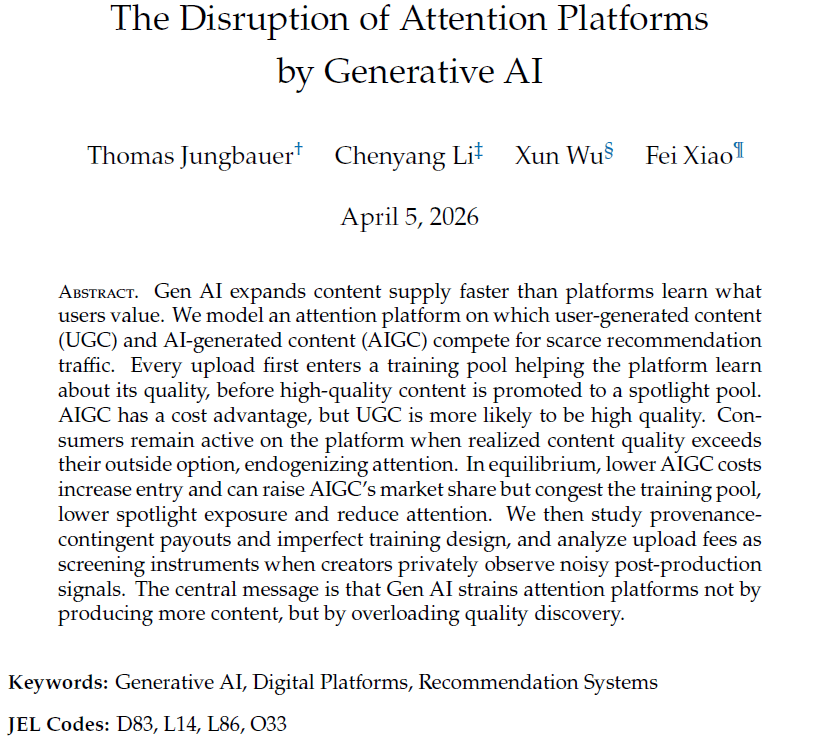
To study this problem, we introduce a simple but powerful framework. On the platform, both user-generated content and AI-generated content compete for recommendation traffic. Every upload first enters a “training pool,” where the platform uses early views to learn whether the content is good enough to deserve wider distribution. Only the content that proves itself is promoted into a “spotlight pool.” In the model, AI-generated content is cheaper to produce, but user-generated content is more likely to be high quality. Users stay on the platform only if their experience is good enough relative to what they could do elsewhere, so bad content does not just waste impressions today. It can also reduce future attention.

The main result is striking: cheaper AI-generated content can make a platform worse off even while it increases supply. The reason is congestion in quality discovery. When too many low-hit-rate uploads enter the system, the platform must spend more scarce human attention evaluating content. As a result, it has less attention left to amplify the winners. That lowers spotlight exposure, reduces realized average quality, and can even shrink the platform’s effective attention budget as users disengage. In other words, more content is not always better. If supply grows faster than the platform’s ability to identify value, abundance can become a liability rather than an asset.

The practical message is not at all that “AI is bad.” It is that AI changes what good platform governance looks like. The paper shows why tools such as provenance-based payouts, better disclosure, upload fees, and multi-stage screening can all matter. They help platforms allocate scarce attention more intelligently and keep low-signal content from overwhelming discovery. For managers, that shifts the strategic question from “Should we allow AI content?” to “How should we redesign incentives and screening when content is cheap but attention is not?” That is a useful lens not just for social media, but for any digital platform whose value depends on matching users with quality at scale.
Search platforms rewrite the rules of online shopping

18 Wednesday Feb 2026

Posted by tjungbau in Digital Economics, Online Advertising, Platforms

≈ Leave a comment

Tags

Market power, Online platforms, Search advertising

The Cornell Chronicle published a nice piece called “Search platforms rewrite the rules of online shopping” breaking down the main message and policy relevance of my paper “Search Platforms: Big Data and Sponsored Positions,” joint with Maarten Janssen, Marcel Preuss and Cole Williams that recently published in the Economic Journal. The main message conveyed: It’s not necessarily advertiser-funded search results that harm consumers, but search platform market power.

Optimally Informative Rankings and Consumer Search

14 Friday Nov 2025

Posted by tjungbau in Academic Research, Digital Economics, Learning, Platforms, Signaling, Strategy

≈ Leave a comment

Tags

Consumer Search, Consumer welfare, Informativeness, Obfuscation, Product rankings

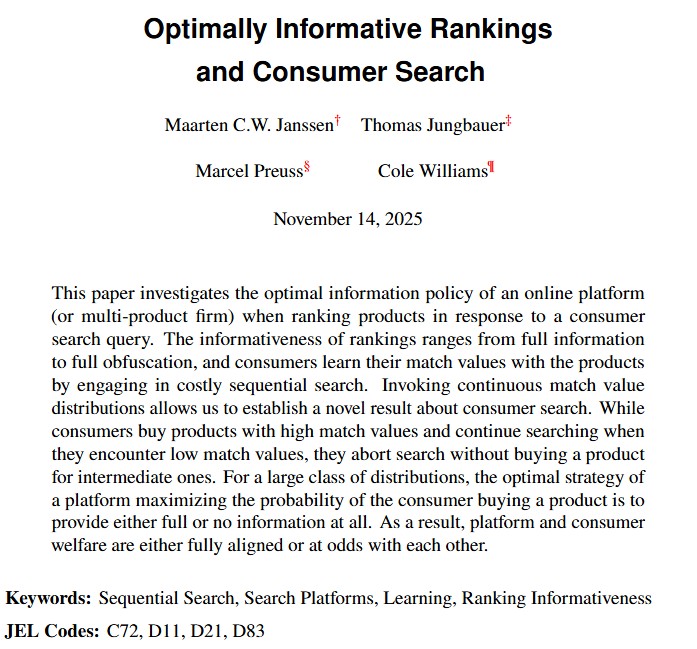
Online platforms (and multi-product firms) generate lists of products (or services) in response to consumer search queries. In ranking these products, platforms draw on their vast amount of information about past consumer search behavior and their purchase history. In “Optimally Informative Rankings and Consumer Search” (joint with Maarten Janssen, Marcel Preuss and Cole Williams), we investigate how much of their pertinent information platforms convey through their rankings of products.

When consumers engage in costly search and expect to find some products they like better and others they like less, they are updating their expectations about the remaining alternatives whenever they inspect a product. As a result, three scenarios ensue: 1) If they like a product very much, they immediately buy. 2) If they strongly dislike a product, they become more optimistic about the remaining alternatives and continue searching. 3) If however, the consumer is fairly indifferent about a product, they may neither buy it nor continue to search as their experience does not induce sufficient optimism about the remaining products. In turn, they abort search altogether without buying a product.

Scenario 3) is a novel finding about consumer search with learning and has meaningful implications for platforms and their regulators. Understanding optimal consumer search behavior, we derive the optimal platform ranking of two products, one of which promises a higher value for the consumer (in expectation) and one a lower value. The more informative the platform’s ranking, i.e., the higher the probability it puts the higher-value product in the first position of their ranking, the higher the likelihood the consumer (inspects and) buys the first product. However, if the consumer does not like the first product, they are less likely to inspect the second the more informative the ranking, i.e., the less likely the product in the second position is the higher-value product.

It turns out that the platform optimally chooses to obfuscate their ranking to increase the probability of the consumer to inspect both products when consumer search cost (i.e., their implicit cost of inspecting another item) is low, but to provide a fully informative ranking to increase the probability the consumer buys the first product if the consumer’s search cost is high. Interestingly, the platform provides either less information than would be necessary to induce search of the second product, or more information than necessary to ensure the consumer’s participation in search in the first place. An intriguing result of our findings is that platform and consumer welfare are aligned only if search cost is high (in which case the platform maximizes social welfare) but at odds with each other when search cost is low.

Search Platforms: Big Data and Sponsored Positions

27 Friday Oct 2023

Posted by tjungbau in Antitrust, Digital Economics, Platforms

≈ Leave a comment

Tags

Consumer Search, Game Theory, Obfuscation

Search platforms (that rely on different business models) such as Amazon, Google or Yelp possess an abundance of consumer-specific data from past searches, purchases, and the behavior of ‘similar’ consumers. When a consumer searches for a product (or service) using a platform’s interface, the platform can invoke this knowledge when listing search results. In creating this list, it has become customary for platforms to sell prominently featured slots, so-called sponsored slots or positions, to firms hoping to steer consumers towards buying their products. Google founders Sergey Brin and Larry Page were on record, as early as 1998, warning of the implications of search advertising: “We expect that advertising funded search engines will be inherently biased towards the advertisers and away from the need of the consumers.” In fact, some of today’s consumers are reluctant to click on sponsored search results to circumvent steering by firms, as they believe non-sponsored (organic) search results promise to be a better match for their preferences.

In “Search Platforms: Big Data and Sponsored Positions,” co-authored by Maarten Janssen, Thomas Jungbauer, Marcel Preuss and Cole Williams, we argue that the issue at hand is more complicated. In fact, we introduce a game-theoretic model analyzing the interaction between a search platform, consumers and firms to show that, when the number of firms is large, it is in the best interest of the consumer to click on sponsored positions, while the introduction of sponsored positions in the first place may either benefit or harm consumers, depending on the platform’s competing objectives. For example, if the platform (also) maximizes sales commission revenue—as is common practice—sponsored slots are beneficial for the consumer. This is because platforms face an incentive to allocate sponsored positions to firms that constitute good matches for consumers in order to increase the revenue from auctions for sponsored positions. On the other hand, obfuscation of organic slots plays a big role in optimal search platform behavior. First, it reduces the consumer’s option value from searching beyond sponsored positions, and, second, it increases the number of positions a consumer inspects if they continue to search among organic slots, thereby increasing the probability of a sale being made.

Our results persist independently of the allocation of consumer-specific knowledge between the search platforms and firms and the variation in prices among firms. Among the major complications to overcome when characterizing optimal platform behavior is that consumers, when inspecting a firm in a given slot, learn about firms in slots they have not yet inspected when they understand the search platform’s algorithm. As a result, we can show that in environments with few firms only, the optimal algorithm of the search platform always depends on the intricacies of the specific problem, and no general rule for the ranking of search results can exist. However, when the number of firms is large—as is customary when dealing with search platforms—the platform behavior as described above is optimal almost surely. In order to prove our results with many firms, we adapt a result from the literature on social learning, the so-called mixing property of stochastic processes, for consumer search problems.

South-Korea’s new regulation on in-app purchases

07 Tuesday Sep 2021

Posted by tjungbau in Antitrust, Digital Economics

≈ Leave a comment

Tags

App store, Google, Market power, Privacy, South korea

I am grateful to BeFM, South Korean public radio, to give me the chance to comment on their show “Morning Wave in Busan” on South Korea’s new legislation trying to rein in the control of tech giants such as Apple and Google over payments for content in their respective app stores. We talked about increasing competition, and thereby potentially increasing quality and/or decreasing prices for consumers, while increased fraud and privacy protection issues will likely bring about a challenge. Find the full interview HERE!

Recent Posts

  • The Disruption of Attention Platforms by Generative AI
  • Selling Synergies
  • Search platforms rewrite the rules of online shopping
  • Optimally Informative Rankings and Consumer Search
  • Education Signaling and Employer Learning Heterogeneity

Recent Comments

Unknown's avatarEfficiency vs. distr… on Applying to multiple specialti…

Archives

  • April 2026
  • March 2026
  • February 2026
  • November 2025
  • March 2025
  • January 2025
  • September 2024
  • December 2023
  • October 2023
  • December 2022
  • September 2021
  • August 2021
  • January 2021
  • December 2020
  • June 2020
  • March 2020
  • November 2019
  • November 2018
  • August 2018
  • July 2018
  • April 2018
  • December 2017
  • February 2017
  • January 2017
  • June 2016
  • April 2016
  • March 2016
  • January 2016
  • December 2015
  • November 2015
  • October 2015
  • September 2015

Categories

  • Academic Organizations
  • Academic Research
  • Antitrust
  • Artificial Intelligence
  • Auction
  • Austria
  • Corporate Social Responsibility
  • Democracy
  • Digital Economics
  • Economic Growth
  • Economics Laureates
  • Education
  • Electric Vehicles
  • Health
  • Inequality
  • Innovation
  • Labor
  • Learning
  • MBA
  • National Resident Matching Program
  • Online Advertising
  • Organization
  • Platforms
  • Politics
  • Probability
  • Self-Driving Cars
  • Signaling
  • Social Dilemma
  • Statistics
  • Strategy
  • Terrorism
  • UBER
  • Voting

Meta

  • Create account
  • Log in
  • Entries feed
  • Comments feed
  • WordPress.com

Recent Posts

  • The Disruption of Attention Platforms by Generative AI
  • Selling Synergies
  • Search platforms rewrite the rules of online shopping
  • Optimally Informative Rankings and Consumer Search
  • Education Signaling and Employer Learning Heterogeneity

Recent Comments

Unknown's avatarEfficiency vs. distr… on Applying to multiple specialti…

Archives

  • April 2026
  • March 2026
  • February 2026
  • November 2025
  • March 2025
  • January 2025
  • September 2024
  • December 2023
  • October 2023
  • December 2022
  • September 2021
  • August 2021
  • January 2021
  • December 2020
  • June 2020
  • March 2020
  • November 2019
  • November 2018
  • August 2018
  • July 2018
  • April 2018
  • December 2017
  • February 2017
  • January 2017
  • June 2016
  • April 2016
  • March 2016
  • January 2016
  • December 2015
  • November 2015
  • October 2015
  • September 2015

Categories

  • Academic Organizations
  • Academic Research
  • Antitrust
  • Artificial Intelligence
  • Auction
  • Austria
  • Corporate Social Responsibility
  • Democracy
  • Digital Economics
  • Economic Growth
  • Economics Laureates
  • Education
  • Electric Vehicles
  • Health
  • Inequality
  • Innovation
  • Labor
  • Learning
  • MBA
  • National Resident Matching Program
  • Online Advertising
  • Organization
  • Platforms
  • Politics
  • Probability
  • Self-Driving Cars
  • Signaling
  • Social Dilemma
  • Statistics
  • Strategy
  • Terrorism
  • UBER
  • Voting

Meta

  • Create account
  • Log in
  • Entries feed
  • Comments feed
  • WordPress.com

Blog at WordPress.com.

  • Subscribe Subscribed
    • A STABLE MATCH
    • Already have a WordPress.com account? Log in now.
    • A STABLE MATCH
    • Subscribe Subscribed
    • Sign up
    • Log in
    • Report this content
    • View site in Reader
    • Manage subscriptions
    • Collapse this bar
 

Loading Comments...