
The main message of my new paper “The Governance of Abundance: Generative AI, Selective Permeability, and Complementor Strategy” is simple to lay out but important: generative AI does not only make it easier to create more products, content, apps, books, videos, or other digital complements. It also makes it easier to make weak offerings look credible. That matters because platforms do not allocate exposure after they perfectly know what is good. They allocate exposure based on signals, rankings, labels, history, verification, and user responses that are themselves imperfect. Once AI makes surface plausibility cheaper, the platform’s problem changes from attracting enough complements to governing too many plausible-looking ones.
The core contribution is to separate two effects that are often blurred together in discussions of generative AI. One is the production effect: AI makes it cheaper to generate complements and can help complementors produce better-looking work. The other is the governance effect: AI can make the signals that platforms use to screen and rank complements less informative. The paper argues that these are not the same thing. A platform can become richer in content supply and poorer in trustworthy information at the same time.
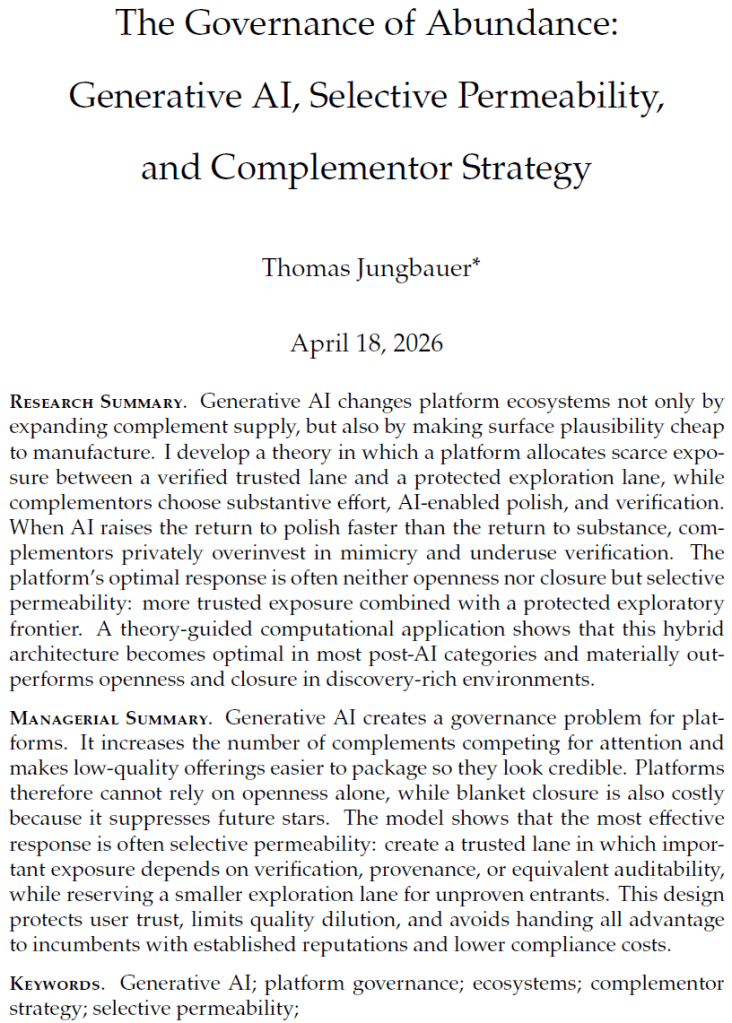
That distinction leads to the paper’s central governance idea: selective permeability. The platform should not necessarily choose between being open and being closed. Openness preserves entry and experimentation, but it can flood users with cheaply polished low-quality complements. Closure protects trust, but it can also suppress future stars and hand too much advantage to incumbents with established reputations and lower verification costs. Selective permeability is the middle architecture: a trusted lane for exposure that depends on verification, provenance, disclosure, or equivalent auditability, combined with a protected exploration lane for unproven entrants.
To study this problem, the paper develops a formal model in which a platform allocates scarce exposure between a trusted lane and an exploration lane. Complementors then choose whether to invest in substantive quality, AI-enabled polish, and verification. The key assumption is that generative AI raises the private return to polish faster than the return to substance. In equilibrium, complementors therefore have stronger incentives to invest in surface plausibility rather than in verified quality. The platform, however, has to internalize two things complementors do not: the trust loss from low-quality exposure and the option value of discovering future high-quality entrants.
The main result is that the best response is often neither full openness nor full closure. When trust matters but discovery also matters, the optimal governance design is hybrid. The platform expands trusted exposure where credibility is especially valuable, while reserving some exposure for exploratory discovery. In other words, the relevant question is not simply “Should the platform allow AI content?” The better question is “Which kinds of exposure should require verification, and how much room should remain for entrants who have not yet built a track record?”
The computational analysis makes this point more concrete. In the formal-model grid, selective permeability is optimal in 123 out of 144 post-AI cells, which means the hybrid regime is not just a knife-edge theoretical possibility. In a representative high-discovery category, selective permeability also outperforms both openness and closure in ecosystem value. It preserves more trust than openness and more discovery than closure. In the post-AI comparison, selective permeability delivers ecosystem value of 4.013, compared with 2.529 under openness and 2.388 under closure. It also raises trust relative to openness and increases discoveries relative to closure.
The paper also has an important implication for complementor strategy. Verification, provenance, and reputation become more valuable strategic assets when trusted exposure becomes more important. That means governance tightening is not neutral. It changes who wins inside the ecosystem. Established complementors and organizations with low compliance costs gain an advantage. But if the platform closes too much, it risks entrenching incumbents and starving itself of the next generation of valuable complements. Selective permeability is therefore not only a trust-protection device. It is also a way to manage the concentration effects of AI-era gatekeeping.
For managers, the practical message is that generative AI turns exposure design into a central strategic problem. Disclosure labels, provenance systems, verification rules, upload frictions, trusted badges, and protected discovery quotas are not merely technical add-ons to recommendation systems. They are governance instruments. They determine which complements receive credibility, which entrants remain discoverable, and how the ecosystem balances user trust against future innovation.
For a broader audience, the paper reframes the AI-platform debate. Much of the discussion asks whether generative AI creates more content or makes individual producers more productive. This paper says that is only half the question. The other half is whether platforms can still tell which complements deserve attention. If AI makes plausible-looking complements abundant but reliable signals scarce, then the strategic bottleneck is no longer production. It is the governance of abundance.

